

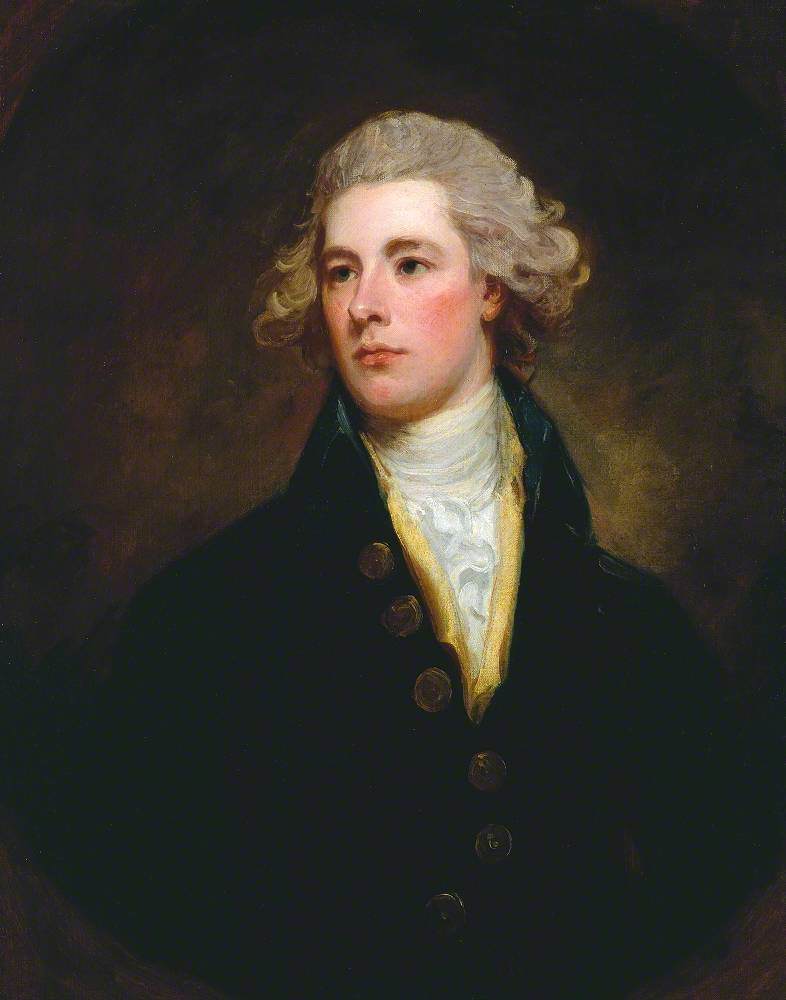
From the onset of his lengthy political career, William Pitt the Younger had his eyes fixed on representing his alma mater, the University of Cambridge. Writing to his mother in July 1779, he observed that the University seat was ‘of all others most desirable, as being free from expense, perfectly independent, and I think in every respect extremely honourable’. In this latest guest post for the Georgian Lords, Natty Sae Jew reconsiders Pitt’s campaigns in Cambridge.
For a young man seeking political independence and prestige but having little by way of financial stability to obtain it otherwise, Pitt’s strategy for targeting Cambridge made sense. But even with his failure at the 1780 election and his rapid turn of fortune, Pitt held onto his conviction. Once the opportunity arose in March 1784, Pitt opted to contest the University again, against the backdrop of his dramatic ascent to power. Standing alongside him was George FitzRoy, Earl of Euston, son of the University’s Chancellor. Opposing them were the two sitting members, James Mansfield and John Townshend, who represented Foxite interests.
While Pitt’s success in the University election seems inevitable in retrospect, this was not the case at the time of the dissolution of Parliament. From the outset, the contest was projected to be very fierce. Writing to his friend the Duke of Rutland, Pitt admitted that Cambridge was ‘unexplored ground’, though he was ‘sanguine in [his] expectations’. Owing to its position as a respectable and pious institution, the electoral culture and processes of the University significantly differed from the disorder often associated with Hanoverian elections. Hustings, dinners, and speeches were prohibited and its erudite electorate was expected to make independent choices which benefitted the nation at large.
Nevertheless, voters still expected to be courted, and with the official canvassing period being only nine days, all candidates had much to keep them occupied. Written correspondence was a key part of the canvassing process. Generic letters from candidates ‘taking the liberty’ to request ‘the honour’ of the recipient’s support were sent to all voters. But more important were the ‘personal application’ letters, used to solicit votes directly. James Talbot, Regius Professor of Hebrew, advised a prospective candidate for the 1700 election that electoral success at the University ‘must be gained by personal application, and the solicitation of private friends, letters from patrons, relations’. [Cook, Representative History, 228-9]. This was an established practice, and Pitt and his agents managed an extensive operation of sending these applications throughout the short and intense canvassing period. Some were sent directly to voters, but they often went to a ‘middle-man’ (sometimes middle-woman) – a friend of Pitt and/or the administration who could make applications to the voter(s) on their behalf.
The relationship between the ‘middle-man’ and the voter varied from patronage and friendship to kinship. In a letter between Pitt’s friends and election agents, John Charles Villiers and Thomas Pretyman-Tomline, an extensive list of ‘connexions’ which ‘sh[oul]d be immediately attended to’ was attached. Unfortunately, the list was quite rudimentary, consisting mostly of pairs of names connected by a single line, for instance: ‘[Thomas] Lund [of St John’s] – L[ad]y Irwine’. A few items contained clues regarding particular connections, such as: ‘L[or]d Aylesford c[oul]d perhaps get us even a single vote from Rev[erend] Mr Barnard of St John’s to which he has just been given a living’. [TNA, PRO 30/8/315]
Pitt and his agents had at their disposal an expansive network of contacts which covered a broad geographical, ideological and institutional range, from the reformers of the Association Movement in Yorkshire to the friends of the King such as William Hayward Roberts, Provost of Eton. The applications were not always successful, but not for reasons one might expect. Mistakes, such as targeting disenfranchised voters, were extremely common. Pre-existing personal obligations or attachments to other candidates also prevented voters from committing to Pitt. Carrington Garrick of St John’s, for example, could not vote for Pitt, having already made promises to Mansfield and Townshend, but was happy for Pitt to instruct him on the vote he also possessed for the Cambridgeshire county election [TNA, PRO 30/8/315]. Rather than political partisanship, it was often the influences and obligations associated with personal relationships which swayed the voters towards particular candidates.
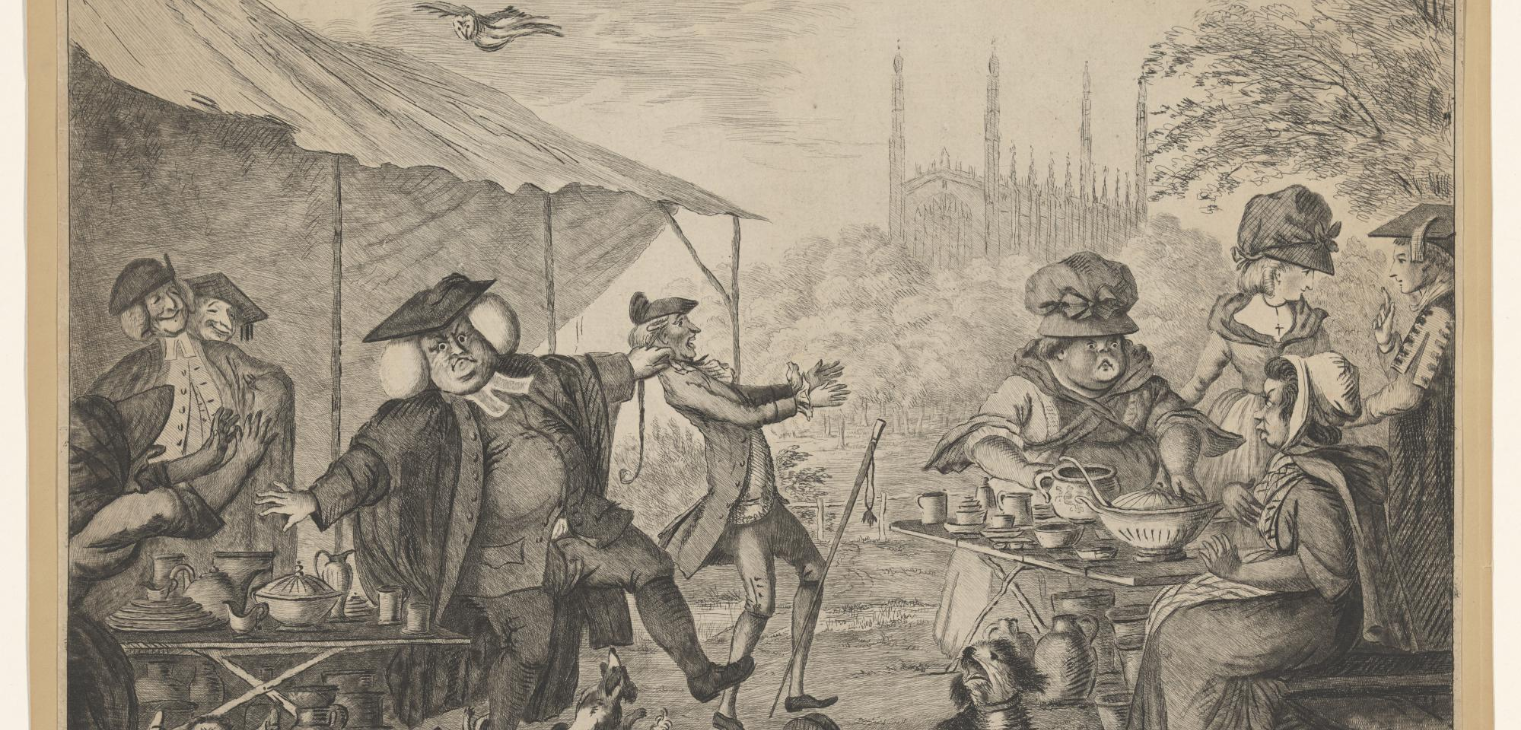
Besides the letters, candidates themselves were expected to be involved on the ground, and their every move was reported in the national press. Letters exchanged between Pitt’s agents emphasised the importance of Pitt being physically present at the University, as he was expected to pay in-person visits to certain key University figures, such as the heads of the colleges. Richard Watson, bishop of Llandaff and Regius Professor of Divinity, recalled in his memoir that during Pitt’s visit, he set out some policy expectations for the Prime Minister-to-be. [Watson, Anecdotes, 211-15]
Throughout the nine days, the contest remained unpredictable. Townshend was projected to top the poll, but Pitt soon took the lead. Mansfield, whose odds were poor from the beginning, reportedly planned to oust Pitt by transferring his votes to Townshend on election day. Euston’s prospects were uncertain, but his affiliation with Pitt would save him from his father’s poor reputation. By election day, set for 3 April, most of the English boroughs had already made their returns, making the University one of the last constituencies to go to the polls before the county elections began.
The University’s election took place, as it always had, in the Senate House, accompanied by the ‘notable Bustle’ from its learned population. The University enjoyed relative control over its electoral process: unlike other constituencies in this period, votes were cast in ‘secret’. Each voter would inscribe his own and his chosen candidates’ names onto a ballot paper (in Latin) before depositing it at a designated table. Each ballot was then read aloud, and subsequently recorded in the poll book. Voting took place throughout the day, with an adjournment in the early afternoon, at which point the number of votes was read out. Once voting resumed, it lasted until the end of the day, and the final count was announced. [Ceremonies Observed in the Senate-House, Wall ed. Gunning, 230-33].
According to the accounts of William Ewin and John Robinson, Pitt was ‘secure’ quite early on in the count, at two o’clock in the afternoon, and there were ‘sanguine hopes’ for Euston. For Ewin, however, Euston’s success was little more than the results of ‘the little Electioneering Tricks of making over Votes & people breaking their words & promises’. Never one to shy away from gossip, Ewin suggested that this was the result of the ‘art’ and machinations used by ‘a Certain great man’. It is unclear whom this comment targeted – Pitt certainly seemed a prime suspect, but it is not unreasonable to assume that it could be the King, who was certainly pleased with the Ministry’s sweeping victory at the University.
Pitt would faithfully represent the University until his death in 1806. Though history has been kind to him, it has been less kind to the University as a political institution. Much like other features of Hanoverian politics, it was lambasted by the Victorians as corrupt and anachronistic. By examining some of its unique characteristics, however, we can begin to recalibrate our understanding not only of Pitt or Cambridge but also of the inner workings of political life in this period.
NSJ
Further Reading
John Cannon, The Fox-North Coalition: Crisis of the Constitution, 1782-4 (Cambridge, 1969)
David Cook, The Representative History of the County, Town, and University of Cambridge, 1689-1832 (University of London PhD thesis, 1935)
John Gascoigne, Cambridge in the Age of the Enlightenment: Science and Politics from the Restoration to the French Revolution (Cambridge, 1989)
Joseph S. Meisel, Knowledge and Power: The Parliamentary Representation of Universities in Britain and the Empire (Parliamentary History: Texts & Studies, 4, 2011)
Peter Searby, A History of the University of Cambridge, Vol. 3 (Cambridge, 1997)
‘William Pitt and Pembroke’, Pembroke Annual Gazette (Pembroke College Society, Vol. 8, 1934), held in Pembroke College Archive, Cambridge

