
Revolutionary Stuart Parliaments

  • The Baronial Context of the 1641 Triennial Act

    The Baronial Context of the 1641 Triennial Act

    Dr David Scott, Editor of the 1640-60 House of Lords section, explores the role of the peers in securing the right of Parliament to meet regularly. The Triennial Act of February 1641 was the first piece of legislation passed by…

  • John Robartes, 2nd Baron Robartes of Truro (later earl of Radnor): reading in the revolution

    John Robartes, 2nd Baron Robartes of Truro (later earl of Radnor): reading in the revolution

    In this guest article, Dr Sophie Aldred, lecturer in Early Modern History at the University of Oxford, explores the library of Lord Robartes and what it tells us of his political position during the revolutionary years of the 1640s. Variously…

  • ‘Good for nothing and lived like a hog’: the destructive obsession of Francis, Lord Deincourt

    ‘Good for nothing and lived like a hog’: the destructive obsession of Francis, Lord Deincourt

    Dr Patrick Little of the 1640-60 Lords section, explores the strange life of a peer who valued money above everything. It had started so well. Francis Leak, the son of Sir Francis Leak, a prosperous landowner in Derbyshire and Nottinghamshire,…

  • Parliament and the Church, c.1530-c.1630

    Parliament and the Church, c.1530-c.1630

    In this blog, Dr Alex Beeton reviews a fascinating colloquium, held recently at the History of Parliament’s office in Bloomsbury Square. In the early modern period, both England’s Church and its Parliament changed. A Catholic country split from Rome and…

  • Oliver Cromwell’s ‘Other House’ and the perils of Lords ‘reform’

    Oliver Cromwell’s ‘Other House’ and the perils of Lords ‘reform’

    In this guest post, Dr Jonathan Fitzgibbons of Lincoln University, looks at a constitutional issue from the 1650s with obvious contemporary relevance: the place of the House of Lords. As politicians continue to debate the House of Lords’ future, including…

  • Lord Saye and Sele and the Battle for Oxford

    Lord Saye and Sele and the Battle for Oxford

    In our first ‘Revolutionary Stuart Parliaments‘ article of 2025, Editor of the 1640-60 House of Lords section, Dr David Scott, considers the leading parliamentarian peer, Viscount Saye and Sele, and his relationship with the archbishop of Canterbury, William Laud. ‘The…

  • ‘Friendship and alliance’: the marquess of Hertford and the earl of Essex

    ‘Friendship and alliance’: the marquess of Hertford and the earl of Essex

    In the latest Revolutionary Stuart Parliaments article, Dr Patrick Little looks at the relationship between two brothers-in-law who ended up on opposing sides during the civil war. William Seymour, 2nd earl (and later 1st marquess) of Hertford married Frances Devereux,…

  • ‘History from above’ and ‘history from below’: the example of Philip Herbert, 4th earl of Pembroke, May to July 1641

    ‘History from above’ and ‘history from below’: the example of Philip Herbert, 4th earl of Pembroke, May to July 1641

    Guest blogger Dr Fraser Dickinson uses the events surrounding Philip Herbert, 4th earl of Pembroke, between May and July 1641, to illustrate the interaction between the paradigms of ‘history from above’ and ‘history from below.’ The past is often viewed…

  • The Sport of Kings – and Protectors!

    The Sport of Kings – and Protectors!

    In this blog, Dr Patrick Little, of the 1640-60 Lords section, explores the enduring popularity of horse-racing, even during the rule of that archetypal puritan, Oliver Cromwell… Oliver Cromwell is blamed for many things without any basis. There are ruined…

  • Crisis? What Crisis? Parliament and Revolutionary Britain

    Crisis? What Crisis? Parliament and Revolutionary Britain

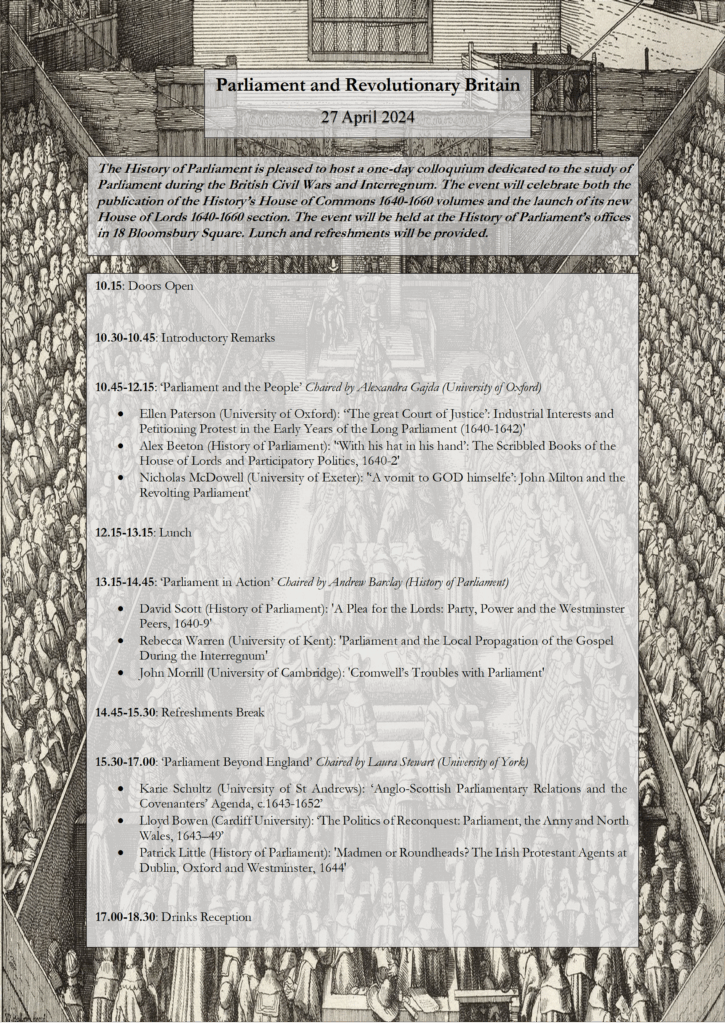
    At the end of April, the History of Parliament hosted a colloquium to celebrate the publication of the House of Commons 1640-60 volumes and the beginning of a new section on the Lords in the same period. In this blog,…

  • New Evidence for Old Stories: The Scribbled Books of the House of Lords

    New Evidence for Old Stories: The Scribbled Books of the House of Lords

    In this blog, Dr Alex Beeton from our House of Lords 1640-1660 project explores a little-used parliamentary source – the ‘Scribbled Books’ – and reveals some of the important information that can be found within them… John Browne, the Clerk…

  • The Stuart Brothers in the English Civil War: the Road to Royalist Martyrdom

    The Stuart Brothers in the English Civil War: the Road to Royalist Martyrdom

    UNIQ+ Intern, Thomas Fallais, and David Scott, editor of the House of Lords 1640-1660 section, consider the deaths of three prominent royalist brothers, and how they were remembered. The Stuart brothers George Lord d’Aubigny, Lord John Stuart and Lord Bernard Stuart came…