Commons in the Civil Wars

  • Approaching the ‘great Court of Justice now sitting’: petitioning and parliamentary memory in the Long Parliament (1640-1642)

    Approaching the ‘great Court of Justice now sitting’: petitioning and parliamentary memory in the Long Parliament (1640-1642)

    Ahead of next Tuesday’s Parliaments, Politics and People seminar, we hear from Dr Ellen Paterson, Keble College, University of Oxford. On 11 March Ellen will discuss petitioning and parliamentary memory in the Long Parliament (1640-1642). The seminar takes place on 11…

  • ‘Until head and knee weary’: motives and formats in the diarizing habit of Sir Simonds D’Ewes during the Long Parliament, 1640-47

    Ahead of next Tuesday’s Parliaments, Politics and People seminar, we hear from Stephen Roberts, emeritus director of the History of Parliament. On 25 June 2024 Stephen will discuss the diarizing habit of Sir Simonds D’Ewes during the Long Parliament. This…

  • Crisis? What Crisis? Parliament and Revolutionary Britain

    Crisis? What Crisis? Parliament and Revolutionary Britain

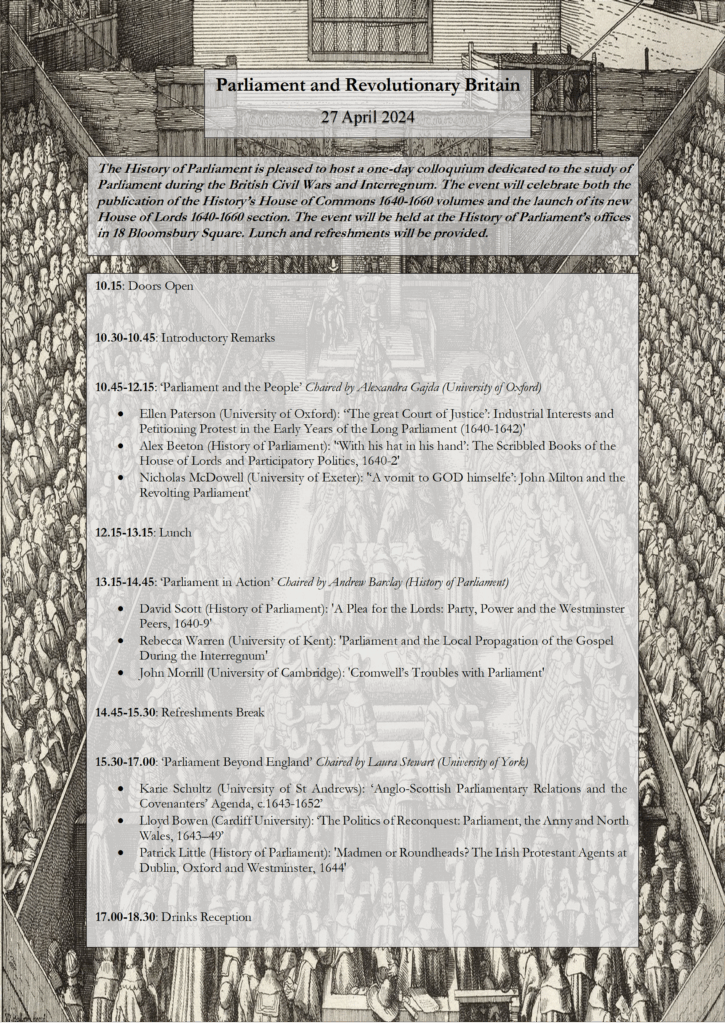
    At the end of April, the History of Parliament hosted a colloquium to celebrate the publication of the House of Commons 1640-60 volumes and the beginning of a new section on the Lords in the same period. In this blog,…

  • The History of Parliament, House of Commons, 1640-60: a roundtable discussion

    The History of Parliament, House of Commons, 1640-60: a roundtable discussion

    Ahead of next Tuesday’s Parliaments, Politics and People roundtable seminar, we hear from Alex Beeton and Patrick Little of the History of Parliament. On 13 February Alex and Patrick will join Andrew Barclay, Vivienne Larminie and David Scott to discuss the recently…

  • Richard Ingoldsby – Reluctant Regicide?

    Richard Ingoldsby – Reluctant Regicide?

    On 29 January 1649, Charles I’s death warrant was signed by 59 men. One of these men, Richard Ingoldsby, later claimed during the restoration of the monarchy that Oliver Cromwell had forced him to sign it. Dr Andrew Barclay, senior…

  • The Civil War and the First Age of Party

    The Civil War and the First Age of Party

    May 2023 saw the publication of the History of Parliament House of Commons 1640-1660 volumes. This research has uncovered that many of the political identities, behaviours and structures that constitute a recognisable party-political system first came together during this time.…

  • Time and the Hard Night’s Day in the Long Parliament

    Time and the Hard Night’s Day in the Long Parliament

    During the 1640s the parliamentary day grew longer and longer until all-night sittings became a regular feature in the House of Commons. Dr Stephen Roberts, editor of the House of Commons 1640-1660, explains the debates that kept the Commons sitting late…

  • The Voice of the Parliamentary Diarists, 1640-60

    The Voice of the Parliamentary Diarists, 1640-60

    May 2023 saw the publication of the History of Parliament’s The House of Commons 1640-1660 volumes. One of the main sources for our researchers was parliamentary diaries. Dr Stephen Roberts, editor for the House of Commons 1640-1660, looks at some of the…

  • Changing sides: ‘turncoats’ in the English Civil Wars

    Changing sides: ‘turncoats’ in the English Civil Wars

    Throughout the English Civil Wars, it was common for people to switch sides between Parliamentarians and Royalists; these people earned the nickname ‘turncoat’. Dr Patrick Little from our Lords 1640-1660 project explores two obscure figures in the Civil Wars and why…

  • Clerks of the Commons: More than just scribes

    Clerks of the Commons: More than just scribes

    The clerks of the Commons in the 17th century have often been depicted as people who simply recorded the events of the Commons. However, as Dr Stephen Roberts, editor of the House of Commons 1640-1660, explains, there is a lot…

  • Contested Space: Politics and the Commons Chamber

    Contested Space: Politics and the Commons Chamber

    The Palace of Westminster was the location of some of the most dramatic events in the English Civil Wars. Dr Stephen Roberts, editor for the House of Commons 1640-1660, discusses the layout of the House of Commons Chamber and its role…

  • Property, profit, principle and hazard: being an MP during the civil wars and interregnum

    Property, profit, principle and hazard: being an MP during the civil wars and interregnum

    Being an MP during the civil wars and interregnum came with a certain amount of danger. The decisions that MPs made often came with severe consequences. Dr Vivienne Larminie, assistant editor for the House of Commons 1640-1660, reflects on the…