
The recent death of HRH the Duchess of Kent, who was married to the late queen’s cousin at York Minister in 1961, reminds us of her family’s long association with Yorkshire. This has included two brothers who served as archbishop of York and several members of her family who were elected to Parliament. Dr Robin Eagles considers the Worsley family’s connection with the north of England.
In 1760 Thomas Worsley of Hovingham, a close friend of George III’s favourite, the earl of Bute, penned a letter to his friend and patron insisting on his family’s antiquity. In their possession, he claimed, were ‘authentic documents of coming over with William the Conquerer’. Worsley’s concern to prove that he was no johnny-come-lately had originally been seen when he was appointed to the privy chamber back in the 1730s, but he was still clearly concerned to emphasise his suitability at the time of his appointment as surveyor general of the king’s works (thanks to Bute).
He had nothing to worry about. The Worsleys were an old family, who could trace their ownership of estates in Lancashire to at least the 14th century. Another branch of the family, ultimately settled in Hampshire (and on the Isle of Wight), produced a parliamentary dynasty of their own.
Supporting Thomas Worsley’s assertion of descent from a companion of William the Conqueror were accounts in ‘ancient chronicles’ recording the family’s progenitor as the giant Sir Elias de Workesley, who had followed Robert Curthose, duke of Normandy, on ‘crusade’. The 1533 Visitation of Lancashire referred to this character as Elias, surnamed Gigas on account of his massive proportions, and suggested he was a contemporary of William I.
It took some time for the northern Worsleys to establish themselves but by the 15th century a number of distinguished figures had already emerged. The marriage of Seth Worsley to Margaret Booth linked the family to two archbishops of York, Margaret’s uncles, William Booth (archbishop 1452-64) and Lawrence Booth (1476-80). Their son, William, later became dean of St Paul’s Cathedral and towards the end of his life became caught up in the Perkin Warbeck conspiracy, for which he was sent to the Tower.
William Worsley may have conspired against Henry VII, but by the 16th century other members of the family had managed to establish themselves on the fringes of the Tudor court in the retinue of the earl of Derby and it seems to have been thanks to the 3rd earl (Edward Stanley) that Sir Robert Worsley was returned to Parliament in 1553 as knight of the shire for Lancashire. Nine years earlier, he had been knighted at Leith in recognition of his services in the English army. Worsley’s return in 1553 seems to have been somewhat accidental, only occurring as a result of a by-election after one of the other recently elected members had declared himself too ill to serve. By becoming one of the Lancashire knights of the shire, Worsley was following in the footsteps of his father-in-law, Thurstan Tyldesley, who had been elected to the same seat in 1547.
Sir Robert’s son, another Robert, continued the family tradition of following the Derbys by attaching himself to the retinue of the 4th earl (Henry Stanley). A passionate Protestant, as keeper of the gaol at Salford he had numerous recusant (Catholic) prisoners in his care, whom he tried to persuade away from their faith by organising time dedicated to reading from the Bible. How successful that policy was is uncertain, but he found the burden of his role intolerable and by the end of his life he had lost all of his principal estates in Lancashire. Like his father, he seems to have owed his election to Parliament to his patron, Derby, though in his case he was returned for the Cornish borough of Callington.
(c) Trustees of the British Museum
The best part of a century passed before another Worsley was returned to the Commons. In the interim, having lost their original estates, the family had relocated to Hovingham, near Malton in North Yorkshire. The manor had been acquired by Sir Robert Worsley in 1563 from Sir Thomas Gerard, and the connection was reinforced by the subsequent marriage of the younger Robert to Gerard’s daughter, Elizabeth. In 1685, it was one of the Hovingham Worsleys, Thomas (great-great-grandson of Robert and Elizabeth), who succeeded in being returned for Parliament, where he proved to be ‘totally inactive’.
Inactive he may have been, but this did not prevent him from making his views clear to the lord lieutenant when he was faced with the ‘Three Questions’, framed to tease out opposition to James II’s policies. In response to them he insisted that he would ‘go free into the House, and give my vote as my judgment and reason shall direct when I hear the debates’. This was not at all the response required by the king’s officials, and he was removed from his local offices. He regained them shortly after at the Revolution but it was not until 1698 that he was re-elected to Parliament, again for Malton. In 1712 he was removed from local office again, this time probably on account of his Whiggery.
The older Thomas lived to see the Hanoverian accession, which he doubtless welcomed. Three years before that his son (another Thomas) had been returned to Parliament as one of the Members for Thirsk, after failed attempts in 1708 and 1710. This Thomas Worsley also seems to have played little or no role in the Commons. This was perhaps ironic, given that his marriage to Mary Frankland linked him directly to Oliver Cromwell. Efforts by his father to secure him a government post through the patronage of the earl of Carlisle came to nothing.
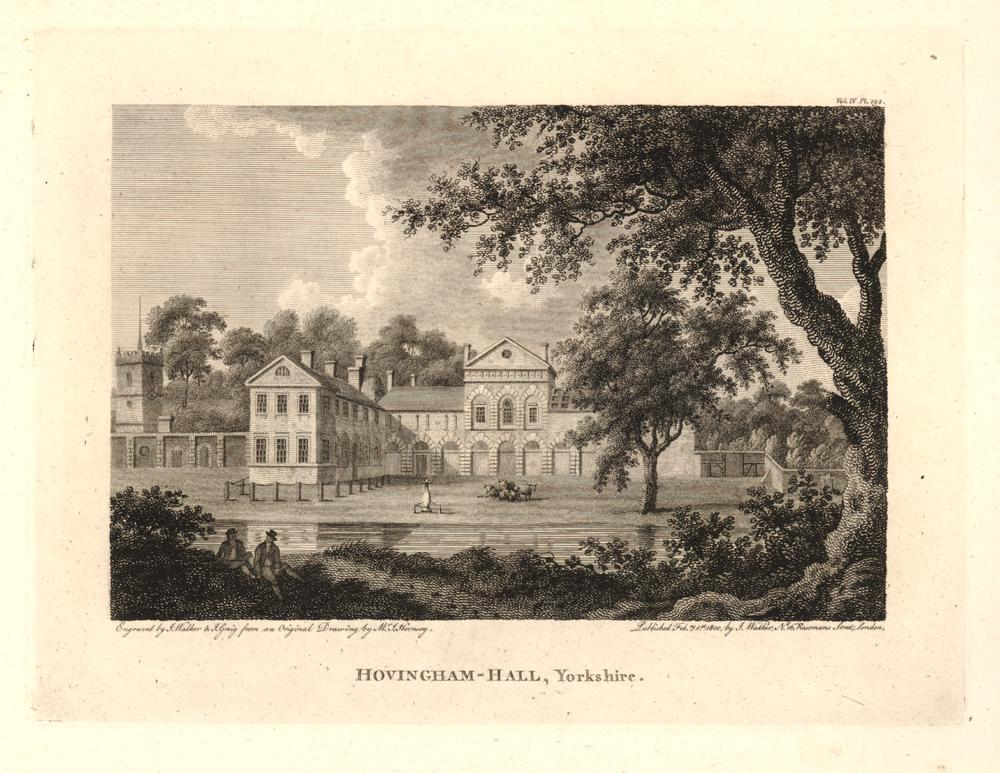
The trio of Thomas Worsleys in Parliament was completed by the election for Orford of the second Thomas’s son in 1761. It was this Thomas Worsley, the friend of Bute, who had been so concerned to prove his family’s antiquity. Although he was to sit first for Orford and then (like his forebear, Robert) for Callington, Parliament was not Thomas’s passion. Rather, his interests lay in equestrianism, collecting and architecture. His true claim to fame was rebuilding the family seat at Hovingham, creating the elegant Georgian house that endures to this day, but his dedication to horseflesh was equally strong and he seems to have looked out for suitable mounts for his contacts, the king among them. Writing to Sir James Lowther, 5th bt. (future earl of Lonsdale) in 1763, he mentioned trying out one of Lowther’s horses in front of the king and queen. They liked the animal, but concluded it was not ‘strong enough to carry [the king’s] weight’. [HMC Lonsdale, 132]
Thomas Worsley died in December 1778 at his London residence in Scotland Yard. [Morning Chronicle, 15 Dec. 1778] Just a few months before, he had been contacted by the duke of Ancaster, the lord great chamberlain, requiring him to see to the repair of the House of Lords, which was reported to be ‘in bad condition’. [PA, LGC/5/1, f. 279] By then, he was probably in no fit state to oversee the work.
This Thomas seems to have been the last member of his family to show much interest in national politics until the 20th century. His eldest son, another Thomas, had died four years before him, leaving the inheritance to a younger son, Edward. In 1838 Edward’s nephew, Sir William Worsley, was created a baronet but his interests appear to have been largely confined to his immediate surroundings in North Yorkshire. The 4th baronet was a talented cricketer, serving as captain of Yorkshire, as well as president of the MCC. It was his son, Sir Marcus Worsley, 5th bt., who finally broke the family duck and returned to Parliament, first as MP for Keighley and latterly for Chelsea. In November 1969 he presented a bill to encourage the preservation of collections of manuscripts by controlling and regulating their export. His other chief preoccupation was as one of the church commissioners.
The late duchess of Kent was Sir Marcus’s younger sister. She continued the family’s long tradition of interest in sport (in her case tennis) and quiet dedication to their locality.
RDEE
Further reading
Estate and Household Accounts of William Worsley, Dean of St Paul’s Cathedral 1479-1497 (Richard III & Yorkist Trust and London Record Society, 2004), ed. H. Kleineke and S. Hovland
VCH Yorkshire North Riding, volume one
Visitation of Lancashire and a part of Cheshire, 1533, ed. William Langton (Chetham Soc. 1876)
