At the IHR Parliaments, Politics and People seminar on Tuesday 28 October, Dr Mari Takayanagi will be discussing ‘The Speakers and the Suffragettes’.
The seminar takes place on 28 October 2025, between 5:30 and 6:30 p.m. It is fully ‘hybrid’, which means you can attend either in-person in London at the IHR, or online via Zoom. Details of how to join the discussion are available here.
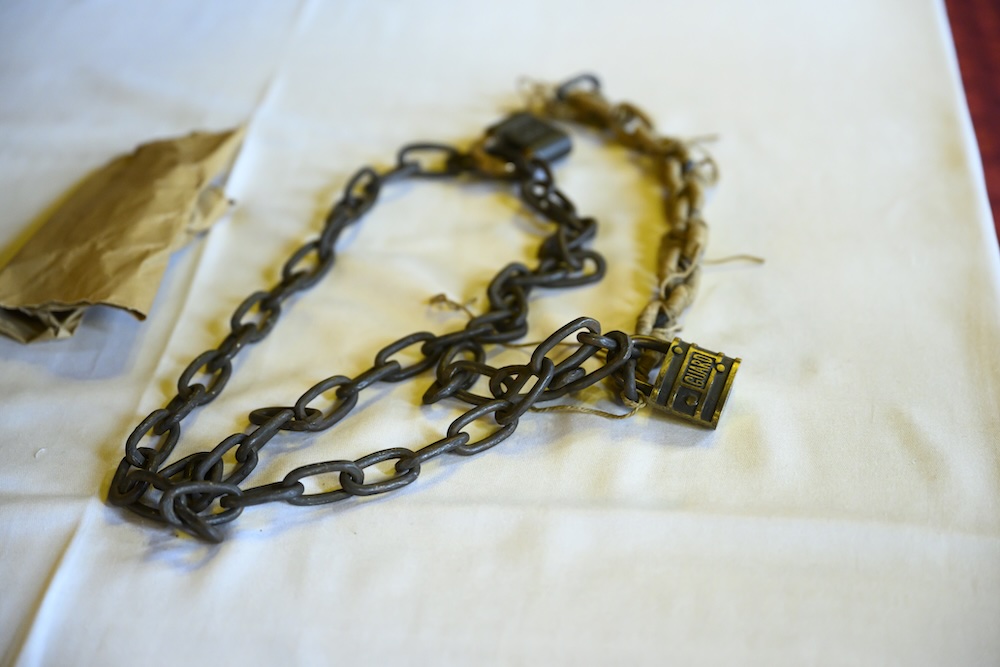
In 2024, the family of J H Whitley, former Speaker of the House of Commons, most generously gave two items to the Parliamentary Art Collection. These were a rosette attached to a medal from Gladstone’s 1884 reform campaign; and a broken chain with padlocks which had been passed down the generations and reputed to be a ‘suffragette chain’.
John Henry Whitley (1866-1935), known as ‘J H’, was Liberal MP for Halifax between 1900 and 1928. His first wife, Marguerita née Marchetti (1872-1925), was President of the Halifax Liberal Women’s Association; her father Guilio fought with Garibaldi in Italy before settling in the UK.
J H Whitley is best known today for giving his name to Whitley Councils, consultative councils between employers and workers, set up following a committee he chaired during the First World War. Whitley Councils continue today in the public sector. In Parliament, he was elected Deputy Chairman of Ways and Means in 1910 and then Chairman of Ways and Means, and therefore also Deputy Speaker, from 1910 to 1921.
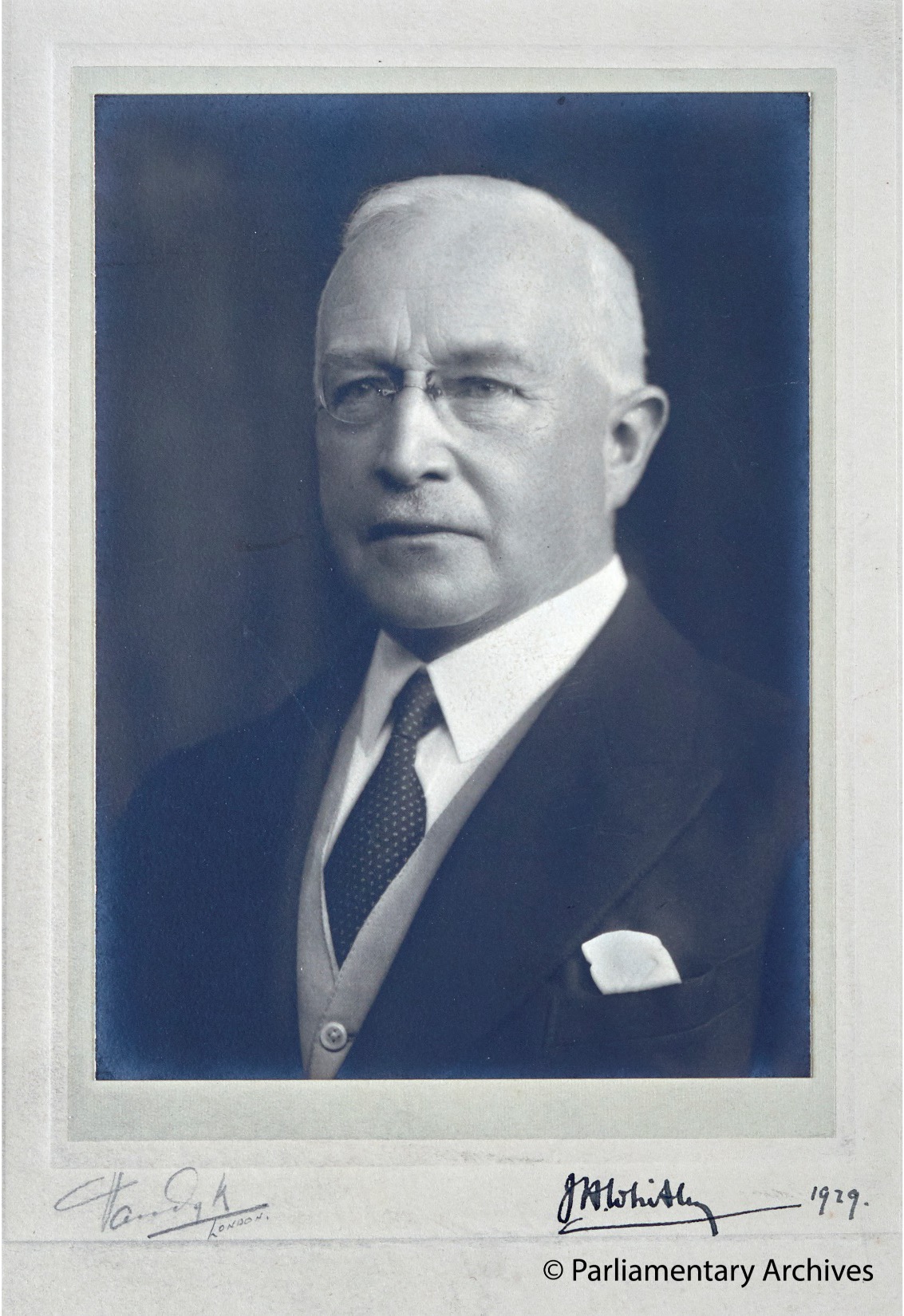
As Speaker between 1921 and 1928 he oversaw the decorative scheme for St Stephen’s Hall. On retiring as Speaker, Whitley refused the customary peerage and went on to other public roles until his death in 1935. He married again in 1928 and his second wife, Helen née Clarke (1882-1981), had been a member of the British community in pre-revolutionary Russia.
Whitley was generally known to be a supporter of women’s suffrage, but this had not been researched in detail until I began to investigate the ‘suffragette chain’. As Deputy Speaker, and then Speaker, Whitley had to be politically neutral, of course; and yet office holders have their own personal opinions, and sometimes these may influence political events.
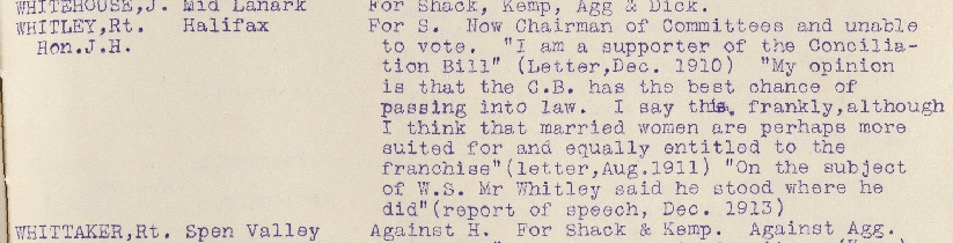
This image is from a report into all Liberal MPs’ attitudes on suffrage from the papers of David Lloyd George, which shows Whitley as a supporter of the first Conciliation Bill in 1910. He expressed support for married women in particular having the vote a year later; and made it clear in 1913 that he had not changed his mind. The Conciliation Bills were unsuccessful cross-party suffrage bills between 1910 and 1912 which would have given a limited measure of women’s suffrage. As private members’ bills they stood little chance of success without government backing.
The Speaker during the years of militant activism before the First World War was James William Lowther, an opponent of women’s suffrage. Lowther had to respond to various suffragette protests in the Palace of Westminster, including at least two known to involve chains. However, Lowther became most infamous in suffrage history for a controversial procedural ruling which scuppered a women’s suffrage amendment to a government bill in 1913. If Whitley had been in the chair, this may not have happened.
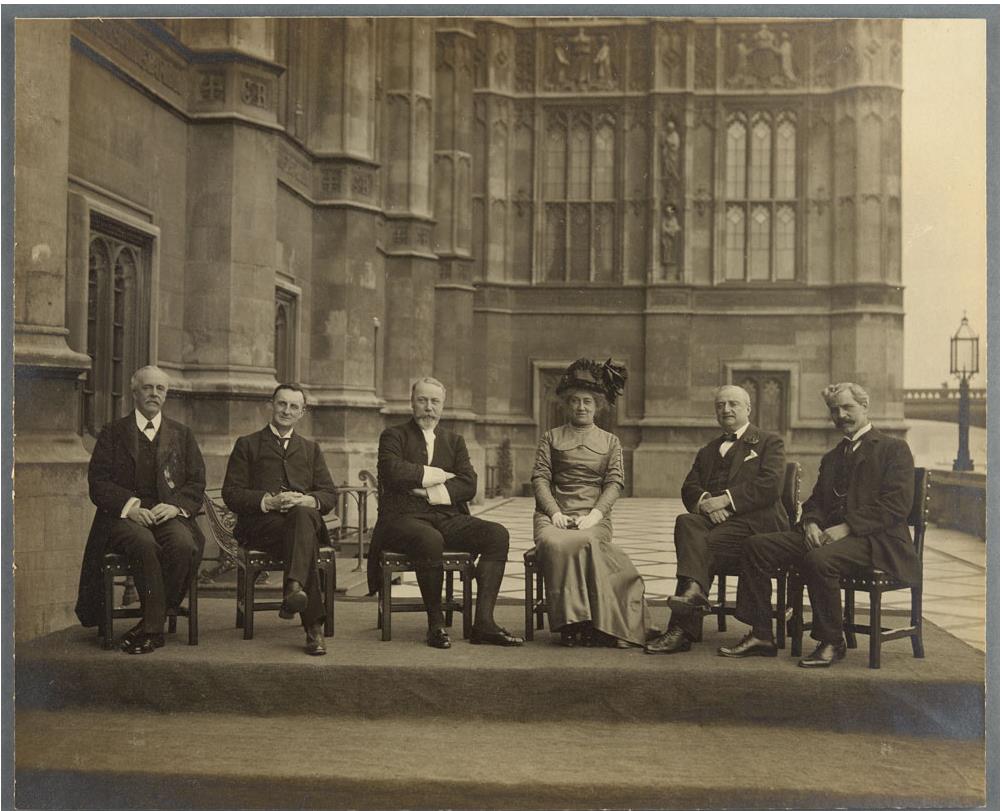
In one of history’s ironies, Lowther went on to (reluctantly) chair the Speaker’s Conference on Electoral Reform during the First World War, which under his leadership recommended a measure of votes for women, implemented in the 1918 Representation of the People Act. The Act gave the parliamentary vote to women aged 30 and over who met a property qualification. The battle for equal franchise went on in Parliament for the next ten years. During this time Lowther took the opportunity to scupper another women’s suffrage bill through a Speaker’s ruling in 1920. He stood down as Speaker in 1921, when he was elevated to the House of Lords as Viscount Ullswater.
In 1924 the Conservative leader Stanley Baldwin made a pledge on equal franchise that his party ‘would if returned to power propose that the matter be referred to a Conference of all political Parties on the lines of the Ullswater Committee’. The Conservatives were elected and in due course Baldwin asked Whitley if he would chair another Speaker’s conference. Whitley refused, much to the relief of most of the Cabinet, who wanted to avoid discussion of wider electoral reform issues.
Despite strong opposition led by Winston Churchill, the Cabinet finally agreed to support equal franchise in 1927 and the 1928 Equal Franchise Act was passed the following year. Whitley oversaw all its stages in the Commons, standing down as Speaker shortly before it achieved royal assent in July 1928. It’s impossible to be sure, but it’s entirely possible that the ‘suffragette chain’ had remained in the Speaker’s Office all these years, until the issue received closure and this suffrage-sympathetic Speaker took it home as a retirement souvenir of his long parliamentary career.
The seminar takes place on 28 October 2025, between 5:30 and 6:30 p.m. It is fully ‘hybrid’, which means you can attend either in-person in London at the IHR, or online via Zoom. Details of how to join the discussion are available here.
MT
Some of this material was first presented by Mari Takayanagi at ‘Breaking the chains: Women’s suffrage and Parliament from the time of J.H. Whitley’, the 12th annual J H Whitley lecture at the University of Huddersfield on 17 October 2024. This year’s lecture will be given by the Speaker of the House of Commons, Lindsay Hoyle, on 30 October 2025.
Mari would like to credit Beverley Cook, Curator of Social and Working History at the London Museum; Kathryn Rix, Assistant Editor at the History of Parliament; and Elizabeth Hallam Smith, academic historian and archives consultant, for their assistance with research on the ‘suffragette chain’.
Further reading:
J. Hargreaves, K. Laybourn & R. Toye (eds.), Liberal Reform and Industrial Relations: J.H. Whitley (1866-1935), Halifax Radical and Speaker of the House of Commons (2018).
M. Takayanagi, Votes for Women and the Speaker’s Conference on Electoral Reform 1916-17. History of Parliament blog (2017).
M. Takayanagi, ‘Women and the Vote: The Parliamentary Path to Equal Franchise, 1918–28’, Parliamentary History, 37:1 (2018).
