

As part of our series on parliamentary buildings, Dr Kathryn Rix of our House of Commons, 1832-1945 project looks at the temporary chamber used by the House of Commons from 1835 until 1851, after its previous chamber was destroyed by fire in October 1834.
The devastating fire at the Palace of Westminster on 16 October 1834 made the House of Commons chamber in the former St. Stephen’s Chapel unusable. The need to prorogue Parliament a week later – amid the still smouldering ruins – prompted makeshift arrangements for both the Commons and the Lords. The small number of MPs who attended gathered in one of the surviving Lords committee rooms, before going to meet the peers in what had been the House of Lords library. A further prorogation in the Lords library took place on 18 December 1834.
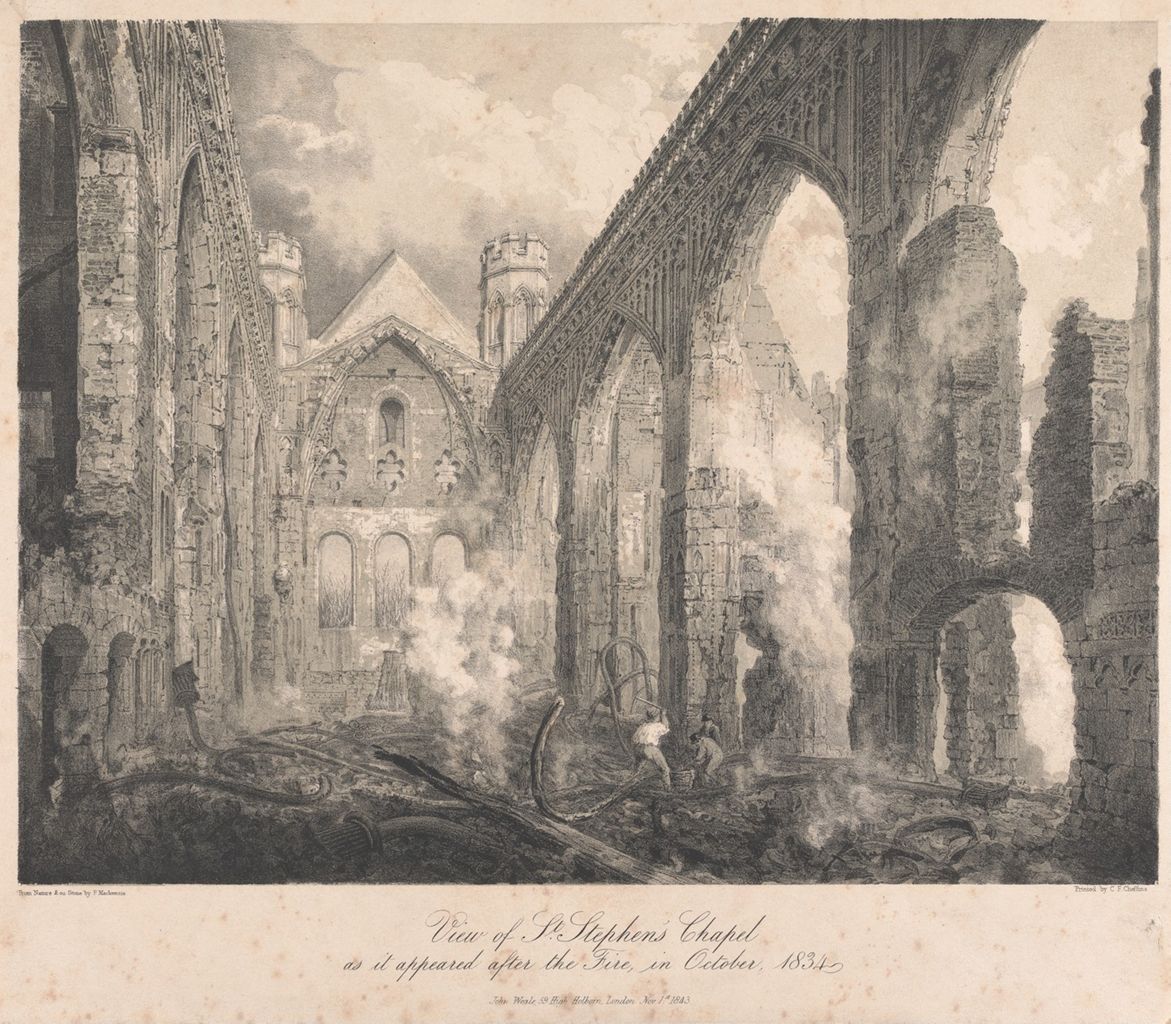
By the time Parliament reassembled in February 1835, the Commons and the Lords had both been provided with far more adequate temporary accommodation, which in the case of the Commons would be in use for the next 17 years. This was rather longer than anticipated, due to the delays which beset the building of the new Palace of Westminster designed by Charles Barry and Augustus Pugin. Some of these delays were exacerbated by the difficulties of constructing new buildings on a site still being occupied by MPs and peers in their temporary accommodation.
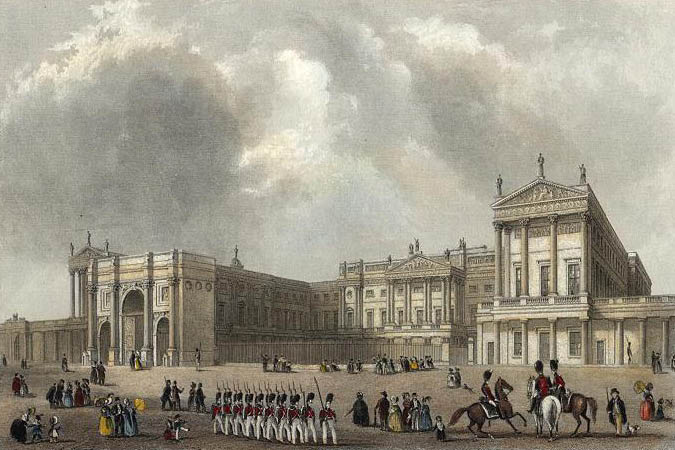
In the wake of the 1834 fire, the possibility of moving MPs and peers elsewhere was discussed, and several alternative locations were mooted, including St. James’s Palace, the Banqueting House in Whitehall, or Exeter Hall, a large public meeting venue on the Strand. William IV offered the recently renovated Buckingham Palace, which he apparently disliked and never moved into, as a possible solution. There were, however, strong objections to this. Its location was considered a major disadvantage: one London newspaper described it as ‘quite out of the way of all business – inconvenient of access’. In addition, it would require a substantial amount of internal remodelling to suit the requirements of parliamentarians, a process which would mean undoing much of the work recently completed at significant public expense. The government tactfully resisted the king’s attempt to foist Buckingham Palace on them.
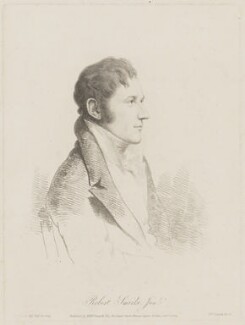
Instead, plans to rehome MPs and peers at Westminster were rapidly drawn up by Sir Robert Smirke, an architect connected with the Office of Woods and Forests, who had been overseeing repairs to Westminster Hall when the fire took place. The House of Commons would use the building previously occupied by the House of Lords as its chamber, while the upper House was displaced into the Painted Chamber. These rooms had both been damaged by the fire and required considerable renovation work, but this began swiftly. Scaffolding was in place on the interior and exterior walls of the former House of Lords less than two weeks after the fire, in preparation for its conversion into temporary accommodation for MPs. By early November, between 300 and 400 workmen were on site roofing the two temporary chambers.
On 19 February 1835, when Parliament assembled at Westminster after a change of government – Viscount Melbourne’s Whig ministry had been replaced by Sir Robert Peel’s Conservative administration – and a general election, the temporary accommodation was ready. This speedy construction was aided by working at night, the use of prefabricated timber and iron girders, and short-cuts such as papier mâché for the ornamental mouldings. The Times gave ‘the highest credit’ to Smirke, who within the limited space allocated had provided ‘accommodation to a much greater extent than could … have been anticipated’.
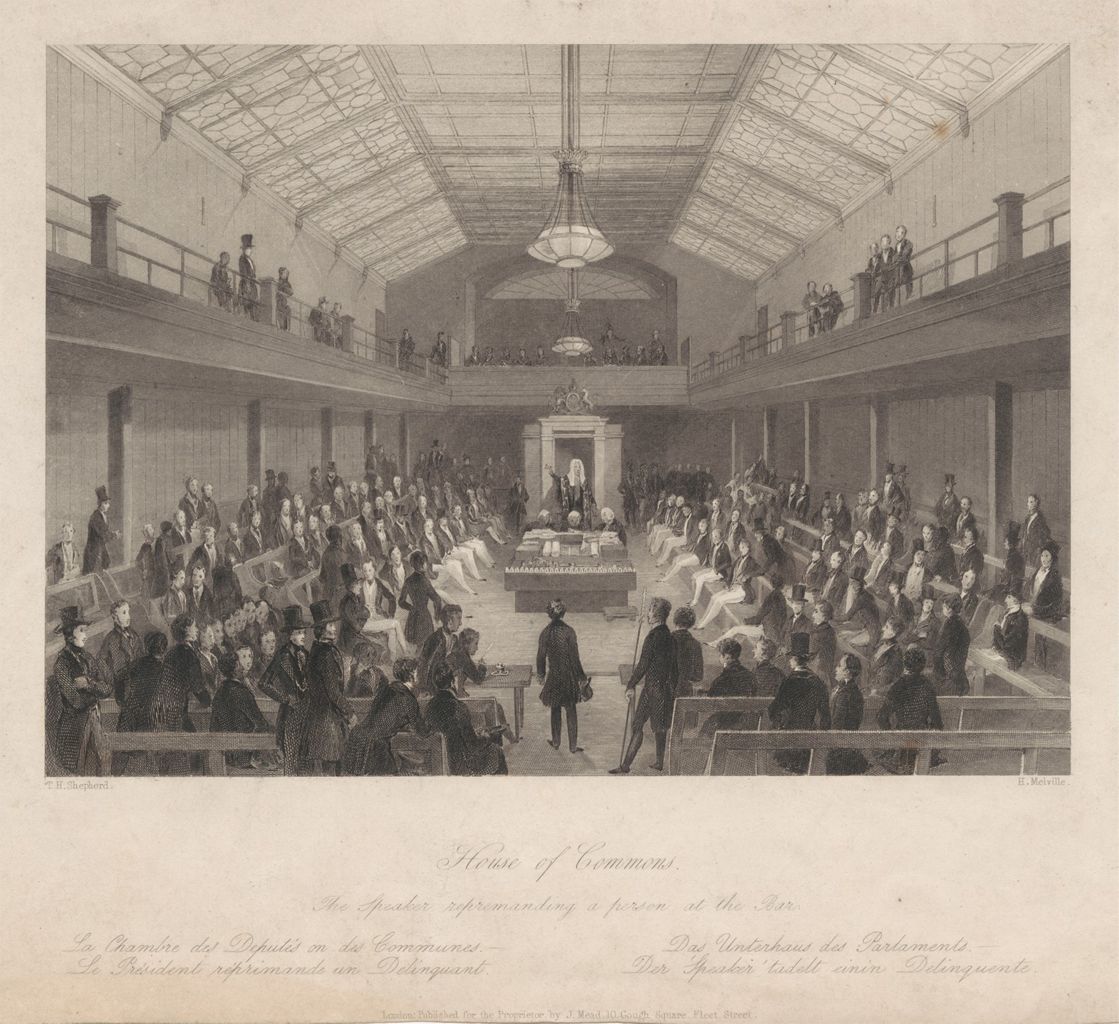
The temporary Commons chamber now included the space which had been behind the throne for the king’s robing room when this building had been the House of Lords. At the opposite end of the House, space was taken out for the lobby, which was made considerably larger than that formerly used by the Lords. The strangers’ gallery was erected above this lobby, roughly where the gallery of the Lords had been, and ‘spacious galleries’ for members were erected on the two long sides of the building.
One ‘most important’ feature, according to The Times, which it had not been possible to incorporate within the confined space of the pre-1834 Commons chamber, was a dedicated reporters’ gallery above the Speaker’s chair, with its own separate entrance. In the old chamber, reporters had been allocated the back row of the strangers’ gallery, but often found themselves jostling with members of the public for seats. Their new gallery recognised the growing significance of the press in reporting on parliamentary proceedings.
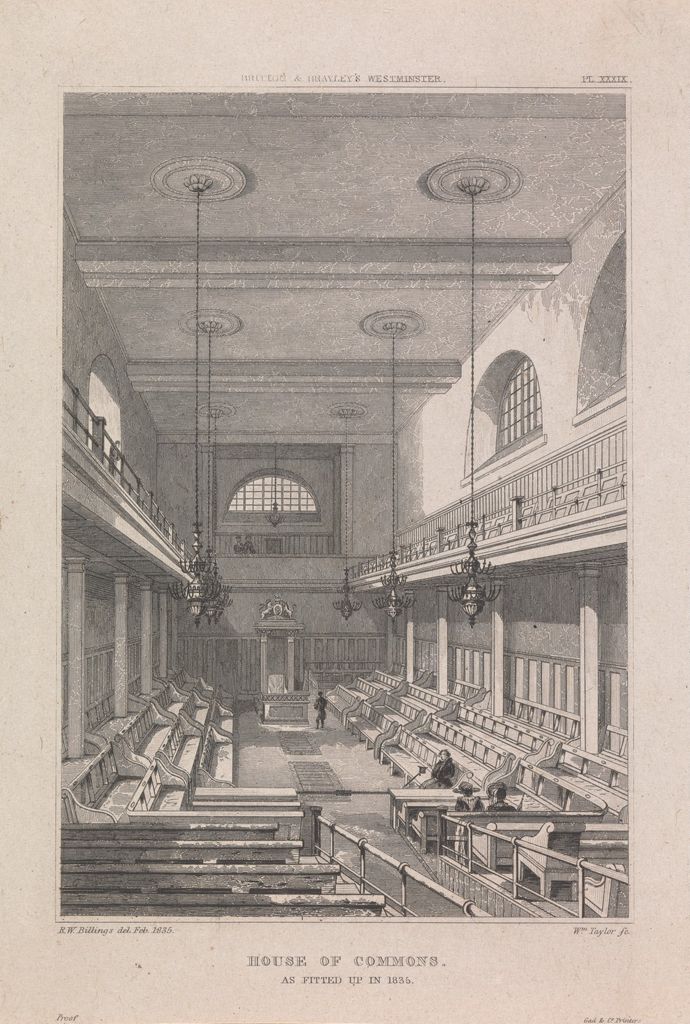
Initial reactions to the temporary Commons chamber were, like that of The Times, generally positive. The Sun described it as ‘perhaps one of the most elegant specimens of taste’, noting the oak seats covered with green Spanish leather, and the ‘simple but most graceful elegance’ of the galleries. While its plainness led some later observers to compare it to ‘a railway station’, ‘a Primitive Methodist chapel’, ‘a hideous barn’ or ‘a wooden shanty’, its ‘conspicuously neat and simple’ style was widely regarded as an advantage. As one guide to London observed, the lack of ornamentation and draperies showed that this was ‘a place of business’.
The temporary chamber also had the major benefit of being able to accommodate a greater number of MPs than their previous one. According to a statement in the Commons in May 1850, it had room for 456 MPs (including in the galleries), in contrast with the 387 who could find a seat in the old chamber. John Cam Hobhouse, who as First Commissioner of Woods and Forests in the Melbourne ministry had been involved with planning the temporary accommodation, recorded in his diary on the opening day of the 1835 Parliament that he ‘was much pleased with what I had some right to call my new temporary House of Commons’. The MP for Bath, John Arthur Roebuck, declared that ‘compared with the old, ugly place, it is a beautiful and commodious room’. The diarist Charles Greville felt that MPs had got the better side of the bargain when it came to their temporary accommodation, contrasting their ‘very spacious and convenient’ chamber with the ‘wretched dog-hole’ provided for the Lords. The temporary Commons was not without its flaws, however, and there were alterations in subsequent years to improve its acoustics, ventilation and lighting.
In addition, questions were raised about the costs of the temporary accommodation. In June 1835, the Commons was asked to approve expenditure of £30,000 for the temporary buildings and £14,000 for ‘furniture and other necessary articles’. The latter was deemed ‘scandalously extravagant’ by one MP, who protested that ‘the country was called upon to pay upwards of 10,000l. for nothing but a parcel of deal tables and a few rusty old chairs’. The ‘utter absurdity’ of money being ‘squandered’ on temporarily patching up parts of the old Palace, on a site which would need to be built on as work on the new Palace progressed, was highlighted in the press. One Warwickshire newspaper drew an unfavourable comparison between the £28,000 cost of Birmingham’s new town hall, a building large enough to hold the members of both Houses, and the expenditure at Westminster. Allegations that this was ‘a job’ by Smirke were given added fuel by the fact that one of the two main contractors for the temporary accommodation, Messrs. Samuel Baker & Son, were related to Smirke by marriage.
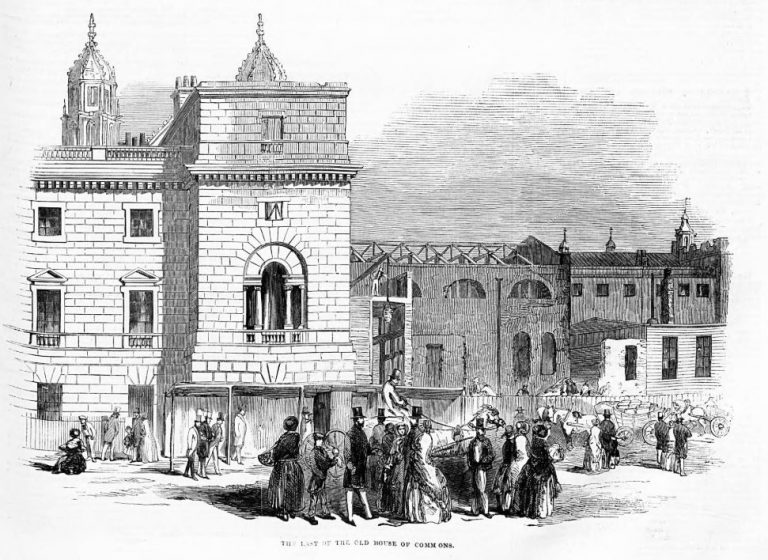
As the temporary accommodation – not only the Commons chamber, but other facilities such as the committee rooms – continued to evolve and to require repair and maintenance over the next 17 years, the costs grew. In 1848, a select committee reported that £185,248 had so far been spent on temporary accommodation for the Lords and the Commons, ‘of which very little will be available for future service’. It argued that this ongoing expenditure was one reason to accelerate the completion of the new Palace. It would be another three years, however, before preparations were finally made in August 1851 to demolish the temporary Commons chamber.
Further reading:
C. Shenton, The Day Parliament Burned Down (2012)
J. Mordaunt Crook & M. H. Port, The History of the King’s Works. Volume VI 1782-1851 (1973)
See also this post by Rebekah Moore which discusses the temporary Commons.
This is an updated version of an article originally published on the Victorian Commons website on 28 October 2022, written by Dr Kathryn Rix.
