
May 2023 saw the publication of the History of Parliament’s The House of Commons 1640-1660 volumes. One of the main sources for our researchers was parliamentary diaries. Dr Stephen Roberts, editor for the House of Commons 1640-1660, looks at some of the key parliamentary diarists from this period.
Other than the official record of Parliament, enshrined in the Journals of Commons and Lords, probably the most significant source available to the historian is the parliamentary or private diary. ‘Diary’ is the word used conventionally to describe this kind of writing, though it encompasses a range of manuscript writings, marked by a variety of styles. The most immediate are the diaries written by serving members of the House of Commons, on a daily basis, on the day of the events they describe, or very shortly afterwards, and the most useful are the diaries sustained over a significant length of time. Though there are significant gaps in coverage, the surviving diaries of Walter Yonge, MP for Honiton, run from September 1642 to December 1645. That of Laurence Whitaker, MP for Okehampton, covers the period October 1642 to June 1647. Sir Simonds D’Ewes, MP for Sudbury, not only kept a diary of events in the Commons from November 1640 to November 1645, but also kept a diary in Latin which from January 1644 complemented his parliamentary diary. For the following decade, the supply of diaries nearly dries up, but the most important of the 1650s are the diaries of Thomas Burton, MP for Westmorland, surviving for the duration of the two Cromwellian parliaments in which he sat, those of 1656 and 1659.

It was probably the drift into civil war in 1642 that impelled Walter Yonge into keeping his diary. Yonge was of a strongly puritan persuasion, an associate of the unsuccessful Dorchester Company of the 1620s, a puritan-inflected, Dorset based venture to colonize lands in Massachusetts. His first diaries date from this period. They are an eclectic mix of national, international and local news, stories and reports that came his way: a chronicle of happenings that struck him as particularly significant. Yonge was strongly providentialist in outlook, seeing for example the hand of God in the death by lightning strike of some people who had defied a call for a public fast. In his diary of the Long Parliament, the same impulse towards compiling a chronicle of public events is clearly visible. In 1642-3 he highlighted reports of the civil war that flooded into Westminster from all over England, the lurid ones attracting more of his attention. As civil war deepened, so Yonge began to take more notice of speeches in the Commons, trying to capture, often in a broken form hard to penetrate fully, the essence of MPs’ speeches that made their mark on him. His primary interest remained in the public affairs of the west of England. Like the 1620s diaries compiled in East Devon, the Westminster ones of the 1640s reveal next to nothing of the character of Walter Yonge himself. He even describes himself in the third person, in lists of committees he records: ‘Mr Yonge’.
A comparable impersonal register of voice is apparent in the diary of Laurence Whitaker. Though he sat for a Devon constituency, Whitaker had before 1640 been a very active JP in Middlesex, particularly zealous in enforcing the laws against Roman Catholicism. This particular enthusiasm carried over into the Long Parliament. His experience in examining suspects took him to prominence in efforts by the Commons to investigate alleged Catholic conspiracies, and to chairmanship of the powerful Commons Committee for Examinations, a shape-shifting body that sent out warrants for arrest and interrogated suspects across a range of offences against parliamentary authority. In his diary, Whitaker habitually uses the plural personal pronoun ‘we’ to describe events in the House, but rarely the singular ‘I’: and then only to record reports he made to the House, never his own thoughts or feelings. Of all the diarists, Whitaker was the closest to power, because of his chairmanships of committees, but also the most impersonal in his writing, as if he were striving to create a journal of record after the model of the Commons Journal itself.
The reader has no struggle to discover the authentic voice of D’Ewes, by some margin the most readable, interesting and insightful of the Long Parliament diarists. Justifiably claiming to be an authority on parliamentary history and procedure, even more devotedly than Walter Yonge he had developed a diary habit before entering the House. It was his intention at the outset to create a record of the Long Parliament. He tells us that his method down to July 1642 was to write up his diary while sitting in the chamber, talking to colleagues and fellow-diarists to capture the essence of a day’s proceedings. Ever sensitive to slights, however, he was offended by allegations in 1642 that he simply cribbed his material from the official Journal. Henceforth, he wrote up in his Westminster lodgings from memory, insisting always that diary-keeping was an exacting task, undertaken ‘until head and knee weary’.
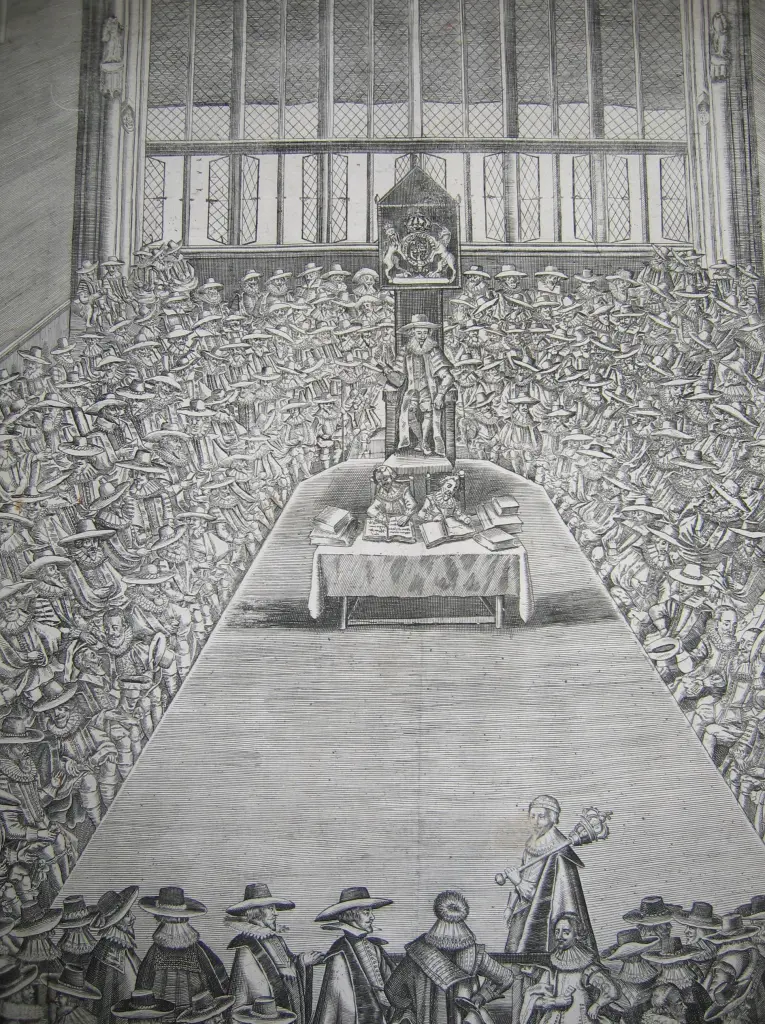
Of these diaries, only in D’Ewes’s is a narrative arc visible. Essentially, it is the story of disappointment. In 1640 he saw Parliament as ‘the greatest means under heaven now left for the preservation of the church and state’, but he quickly became disillusioned by the growth of faction, appalled by the outbreak of civil war and horrified by the reluctance of the parliamentary leadership to compromise with the king. These public disasters coincided with a series of insults to his personal pride: none more cutting than a humiliating sneer directed his way by Speaker Lenthall in front of the whole House, calling into question his integrity as an authority on parliamentary procedure. The cumulative effect of these blows was to sour D’Ewes’s love affair with Parliament. While some MPs, the radicals, or ‘fiery spirits’ as D’Ewes famously described them, threw themselves into managing the war effort against the king, keeping longer hours in the House, D’Ewes shortened his working day, becoming progressively more marginal to its proceedings. The diary became reduced in scope and coverage. The number of unflattering references in it to colleagues increased, as did dismissals by D’Ewes of whole areas of parliamentary business as trivial. Nevertheless, his detachment has brought us some benefits. After his idealism had evaporated, he adjusted his purpose in diarizing. From mid-1642, he kept writing ‘in some measure so to transmit not only the story but the very secret workings and machinations of each party’. In other words, he saw himself as the historian of faction.
In Thomas Burton, member of Oliver Cromwell’s 1656 Parliament and Richard Cromwell’s only Parliament, we have a diarist uniquely gifted at capturing speeches. D’Ewes devoted space only to recording his own orations; Yonge often left only obscure summaries, and Whitaker recorded orders and actions, not a word-picture of oratory. Burton was more interested in regional legislation rather than great affairs of state, so perhaps his limited range of interests qualified him for the role of dispassionate diarist. His six volumes, in a crabbed hand, focus on MPs’ speeches, which he somehow took down almost verbatim, seemingly writing virtually as members were on their feet speaking. The principle of self-effacement once more asserted itself in the case of Burton, whose diaries reveal almost nothing of their author’s politics. But diary as autobiography is hardly the principal value of these sources. Rather, we rely on them to bring life to the dry record of parliamentary transactions: any insights into the lives of the diarists are an added treasure.
SR
