
Of all the bizarre voting qualifications in operation before 1832 – from potwallopers to burgage holders – one of the most striking was the freedom-by-marriage franchise. Philip Salmon explains how this system worked and even survived briefly after 1832, contrary to what has been widely assumed.
The freeman-by-marriage franchise remains one of the most paradoxical elements of the UK’s pre-democratic voting system. Women may not have been able to vote in most parliamentary elections (although as discussed here this did occasionally happen before 1832), but in certain boroughs the daughters and widows of freemen were able to transfer the privilege of voting to their husband. This female ability to ‘enfranchise’ has long been recognised. But it has yet to receive the sort of analysis, backed by archival evidence, that in recent years has begun to reveal so much about the ‘forgotten’ presence of single women as voters in local elections.
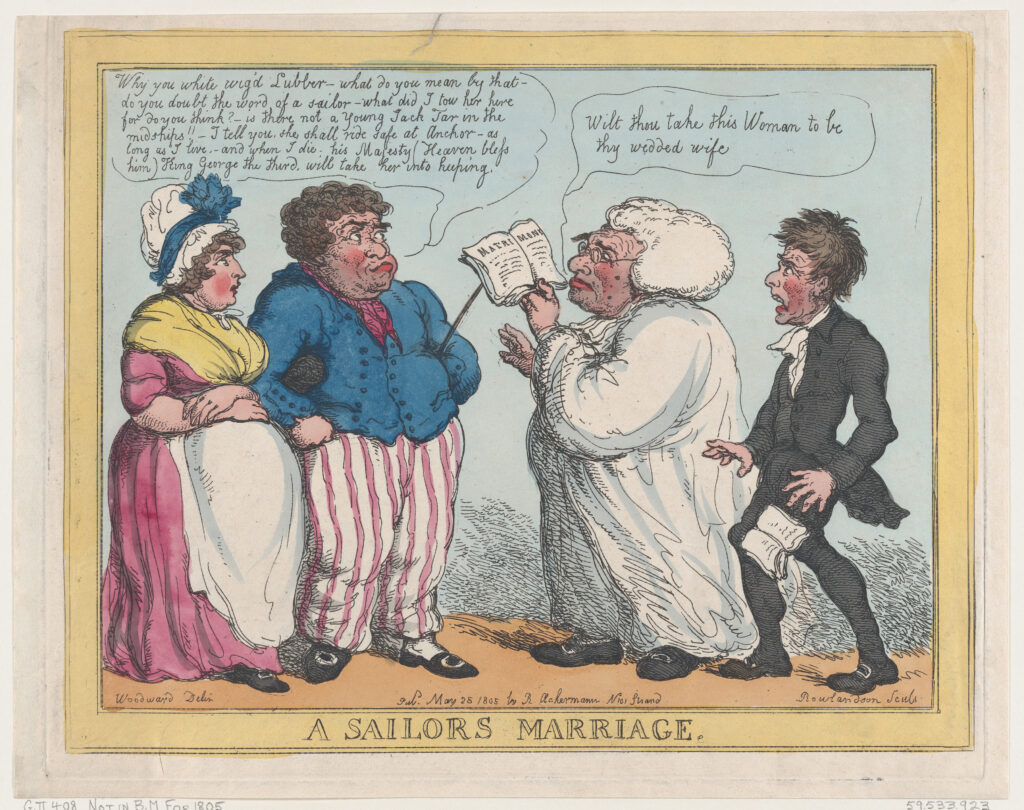
Alongside the vote, with its huge potential for financial gain, freemen enjoyed many other privileges, such as exemptions from local tolls, exclusive trading and grazing rights, plus access to free or subsidised schooling. Marrying a freeman’s daughter (or a freeman’s widow) and becoming a freeman could therefore be transformative. Satirical jibes about it being the only way some females could marry, because they lacked ‘sufficient personal charms to get them husbands’, as one MP put it, were a cruel but standard feature of much contemporary debate about this ancient system. Bristol’s ‘maidens’, in particular, seem to have been considered incapable of making any match without such incentives.
My research suggests that this system was more widespread than previously thought. Of the 90 English and Welsh boroughs that continued to operate a freeman franchise before 1832, fifteen maintained some sort of freedom-by-marriage qualification. In roughly one-sixth of the old freeman boroughs, women could therefore inherit and possess a vested right in a similar way to their male siblings, enabling them to act as ‘enfranchisers’, though not as electors themselves. At a time of ever-increasing male dominance in many formal political processes, this level of female agency in the representative system is perhaps surprising and has yet to receive much historical attention.
The way this franchise functioned was far from uniform. Like virtually everything else in local government around this time, it was subject to all sorts of local customs. In Maldon, daughters passing on their father’s freedom to husbands had to have been born after their father had become a freeman. They could also only enfranchise once – second or subsequent husbands could not take up the freedom, a rule also enforced in Hythe, Malmesbury and Sandwich.
In Bristol, however, widows could enfranchise a second husband, ‘but on the 3rd or any subsequent marriage’ were then ‘subjected to a fine of 40s.’ before their new husband could be admitted. Given the range of local benefits beyond voting also associated with being a freeman, this hefty fine may still have been worth paying, although it does suggest an institutional disapproval for getting through too many husbands.

In Dover meanwhile, the role of the daughter in the enfranchisement process did not end with her marriage, but remained in force even after her husband’s admission. In an extraordinary example of female instrumentality in the electoral process, a husband’s freedom (and right to vote) was ‘determined by the death of his wife’, with freemen admitted by marriage losing their voting rights when their wives died.
The number of freemen voters admitted via marriage (as opposed to other methods) could be significant. In Canterbury marriage freedoms accounted for 150 (or one sixth) of all the city’s 900 admissions in the decade before 1832. In Sandwich the proportion was almost double that, at around a third of all enrolments, while in Ludlow marriage accounted for 29% of all the freeman admissions made between 1800 and 1831.
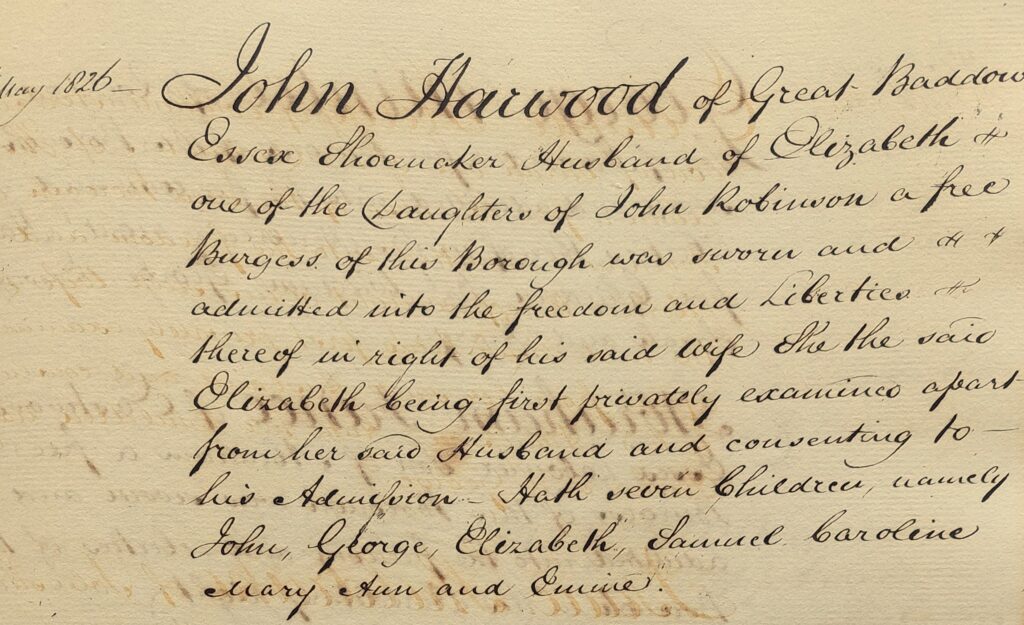
A rare collection of original admission registers from Maldon offers an intriguing insight into how this system operated. Between 1810 and 1825, some 691 freemen were admitted to the freeman franchise, 259 (37%) of them claiming as the husband of an entitled daughter. Crucially, the surviving registers for these admissions reveal that the consent of a wife was required before the husband could make any use of her birth right. All wives had to be ‘first privately examined by the mayor’ to secure their agreement. These interviews took place regardless of the rank of the male applicant, with professionals and local elites having to obtain female consent in the same way as working men.
The system used to secure a wife’s permission seems to have become more rigorous over time. In 1826, the year of a notorious election campaign, a vast number of ‘bridegrooms’ were ‘presented by their brides for admission’. Maldon’s registers now started to record wives being examined by the mayor not just ‘privately’, but also ‘apart from her said husband’. This process of a wife having to provide her independent consent suggests a degree of genuine agency by women in the enfranchisement process. In total, the number of voters enfranchised by marriage claims accounted for over 1,100, or 36%, of the 3,120 electors who polled in Maldon’s 1826 election.
During the debates on the reform bill various attempts were made to preserve the freedom-by-marriage franchise from abolition. John Wilks and T. B. Lennard, in particular, campaigned hard on behalf of the daughters of freemen, especially once the reform ministry agreed that sons could continue to inherit their father’s freedom and become freemen by ‘birth’.
The debate on Lennard’s motion to preserve the franchise, however, ended up being accompanied by ‘much laughter’. Complaining that these female ‘rights’ had become ‘a kind of dowry’, one MP insisted that they had only been granted to the ladies of Bristol ‘because they were supposed not to possess sufficient personal charms to get them husbands’. It was because ‘of their being remarkably plain’, agreed the next speaker. ‘I think the best mode to pursue’, another MP quipped, ‘would be to permit a lady to claim this privilege for her husband, provided she pleads ugliness as the ground’. After the leading Whig Lord Althorp alleged that in some places ‘ladies have been shut in a room waiting to be married to those men who would promise their votes’, Lennard’s amendment was defeated by 50 votes.
Under the terms of 1832 Reform Act, future freemen voters could only be admitted by birth and apprenticeship. It might be thought this was the end of the marriage system. But by an strange oversight in the drafting of the Irish Reform Act, freedom-by-marriage was inadvertently given a new lease of life. In Dublin, where marriage claims had previously been classified alongside ‘grace especial admissions’, a ‘new’ and ‘distinct right by marriage’ was created by the imprecise wording of the clauses restricting ‘honorary’ freemen. Daniel O’Connell reckoned that as a result over 100 new marriage admissions had been carried out by 1835. Questions about these admissions eventually prompted a series of investigations into ‘fictitious’ votes and the status of these gendered ‘rights’ in Ireland, where freemen voters were still being admitted by marriage and voting as late as the 1840s. But that, as they say, is another story.
PS
