

In the latest blog for the Georgian Lords, Dr Robin Eagles examines the career of one of the lesser known Archbishops of Canterbury, who was able to make use of his August 1715 sermon celebrating the accession of George I to press forward his career in the Church.
Every 30 January, the rhythm of the parliamentary session in the 17th and 18th centuries was adjusted to make way for the annual commemoration sermon, marking the death of Charles I in 1649. It usually fell to the most junior of the bishops to preach to the Lords in Westminster Abbey, while a senior member of the clergy would perform the same service for the Commons in St Margaret’s. Themed as they were around the subject of expiation for the sins of the nation, the sermons became steadily less well attended as the years went by and by the second half of the 18th century some, like John Wilkes, thought that they should be scrapped and replaced with a day of national rejoicing. Wilkes always made a point of staying away from the chamber on 30 January.
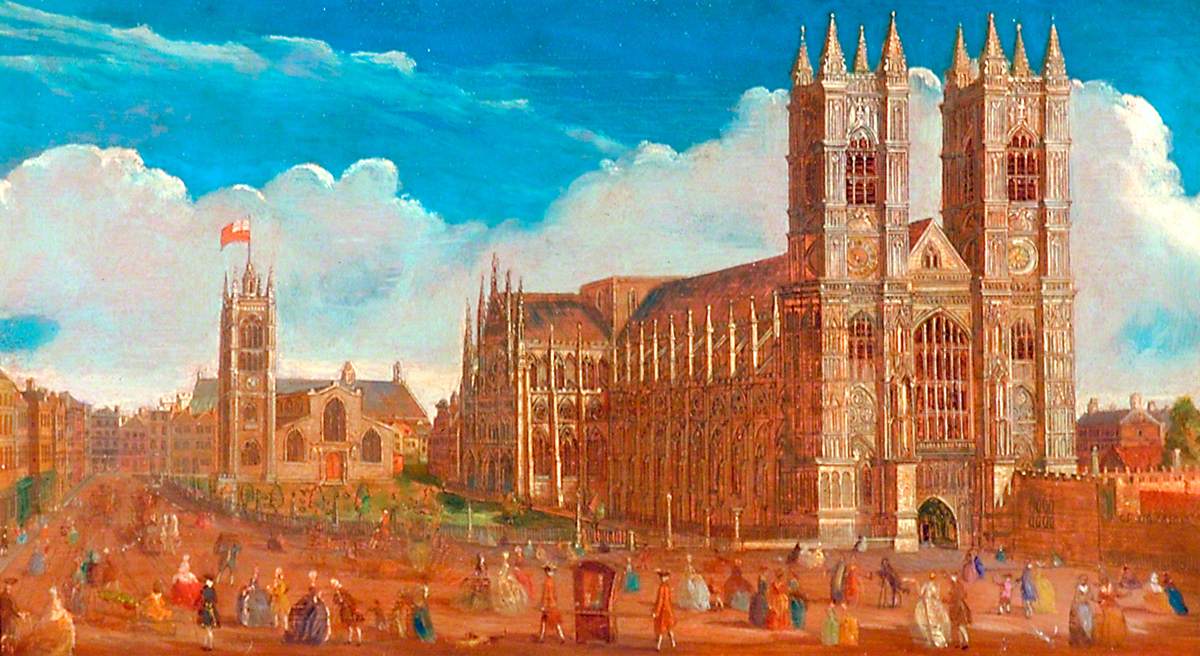
In a similar (though more celebratory) way, the date of the current monarch’s accession was also the occasion for the Members decamping from their chambers and heading across the way to listen to a sermon. For those living under George I, this took place on 1 August and the very first anniversary of his accession in 1715 was marked with an address by the newly minted bishop of Oxford, John Potter (1673/4-1747).
Potter’s background was unusual, though not entirely unique, for an 18th-century bishop. His father had been a linen draper in Wakefield and, more to the point, had been a nonconformist. Potter had been raised as such and educated at the local grammar school (now one of the constituent parts of the Wakefield Grammar School Foundation). From there he proceeded to Oxford, where he transformed himself into a high church Anglican, much to his father’s disgust. Although high church, and with a particular interest in patristics (the study of the early church), Potter remained a confirmed Whig and quickly attracted patronage from some extremely influential people.
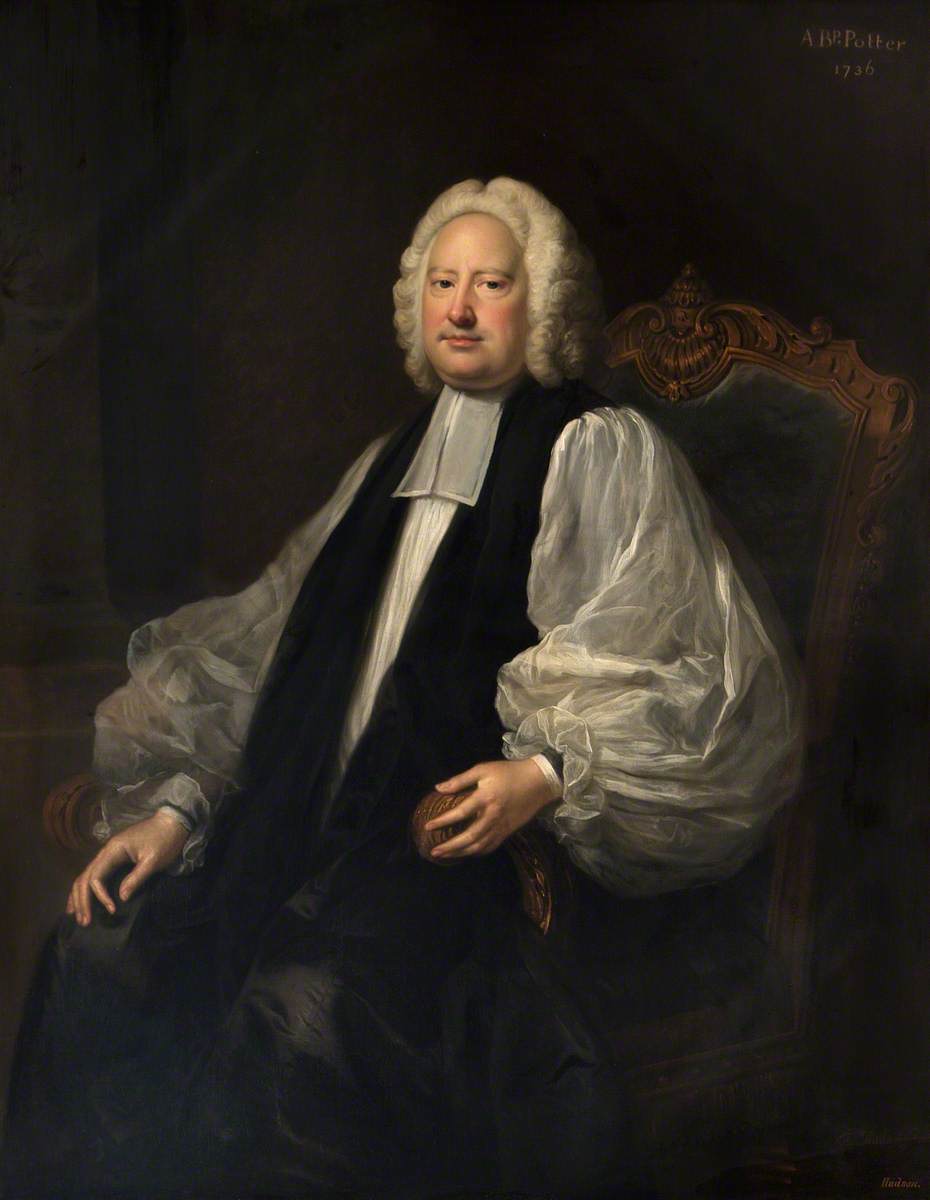
From University College, where he had been an undergraduate, Potter proceeded to Lincoln College as a fellow and in 1699, the year of his ordination to the priesthood, he was appointed one of the chaplains to Bishop Hough of Lichfield and Coventry. In 1704, he traded up becoming one of Archbishop Tenison’s chaplains and was thought so closely tied to Tenison that he was known as his ‘darling scribbler’. Two years later, he achieved the key promotion to royal chaplain.
As a clergyman at Court and with close connexions to Oxford, it is perhaps not surprising that he came to the notice of the duke and duchess of Marlborough, and when the regius professorship of divinity became vacant at Oxford, he was their candidate for the place. In his way was the rival claim of George Smalridge, backed by Robert Harley and others, but in the end the Marlboroughs won out (as was so often the case) and in 1708 Potter became Professor Potter.
For the next few years, Potter focused his attentions on his role at the university, never apparently being considered seriously for any of the vacant bishoprics that came up. Indeed, in 1714 it was Smalridge who was promoted first, taking on the poverty-stricken bishopric of Bristol. However, soon after the accession of George I another opportunity arose following the death of Gilbert Burnet, bishop of Salisbury. Thus, when Bishop Talbot of Oxford was translated to Burnet’s vacant see, Potter was appointed to replace him at Oxford.
Potter’s 1 August sermon was his first major opportunity to make his mark in his new role. Unsurprisingly, he attracted criticism from Jacobite Tory opponents like Thomas Hearne, at that point still in post as one of the librarians at the Bodleian, but soon to be forced out as he was unwilling to take the oaths to George I. Recording the sermon a few weeks later, Hearne noted that it had been preached by ‘our present sneaking, poor-spirited, cringing, whiggish bishop’. The content, he thought, was ‘vile, silly, injudicious, illiterate, & roguish stuff, sufficiently showing what the author is’. [Hearne, v. 122] Hearne never lost an opportunity of deriding Potter using terms like ‘snivelling’ or ‘white-livered’ to describe him. [Hearne, vi. 123; ix. 360]
Potter’s chosen text was Psalm 20, verse 5: ‘We will rejoice in thy salvation, and in the name of our God we will set up our banners’. His theme, obviously enough, was the blessings the nation had received by the peaceful succession of the House of Hanover, and how narrowly they had avoided the prospect of civil war. Not only was the nation peaceful, he urged but he may also have had half a mind on his own significant progress when he argued:
Neither can there be any just complaint, that arts and industry, virtue and public services want suitable encouragement; where the way lies open for ever man to advance himself to the highest honours and preferments and after he hath enjoyed the fruits of all his labour in his own person, there is as great certainty… that he shall transmit them entire to his posterity…
As well as lauding the prospect before them under the house of Hanover, Potter also allowed himself some predictable venting against the horrors of life under a Catholic sovereign. Even other religions, he suggested, might be ‘kind and merciful’. He also trotted out the familiar theme of the importance of divine providence in settling King George among them.
Over the next few years, Potter developed his role in the Church, becoming a close associate of William Wake, archbishop of Canterbury, and co-operating with him closely in opposing two pieces of government-backed legislation. He attracted attention for wading into the ‘Bangorian controversy’, criticizing the apparent Arianism of Benjamin Hoadly, bishop of Bangor. Even Hearne had to acknowledge that he did so ‘very deservedly’. [Hearne, vii. 82] He also became close to the Princess of Wales, the future Queen Caroline.
When George I died it was widely rumoured that Potter would be promoted to Bath and Wells. Although that proved not to be the case (he seems to have turned the promotion down) he was the person selected to preach the new king and queen’s coronation sermon in October 1727. Controversially, for a Whig, he used high church terminology to justify George’s claim to the throne by hereditary right. [Smith, 37] More controversially, for a Whig, he also emphasized the need for the new king’s subjects to give their ‘entire submission to his authority’.
It was to be another decade before Potter was finally rewarded with a richer diocese. On Wake’s death in 1737, it was Potter who became Archbishop of Canterbury, rather than Bishop Hare of Chichester, backed by Sir Robert Walpole. The translation was widely attributed to the queen’s personal intervention and came just a few months before her death later that year.
Potter may not be the best-remembered of 18th-century bishops, or indeed a particularly memorable Archbishop of Canterbury. Much more attention is paid to his younger son, Thomas, a Member of Parliament, associate of the so-called Hellfire Club and a generally archetypal Georgian rake. But Potter was important in showing that the Church of England was able to adapt in the period, adopt language used by the Jacobites to justify the Hanoverian monarchy and was open to advancing the son of a Yorkshire linen draper, and a nonconformist one at that, to the highest place in the Church.
RDEE
Further reading:
J.C.D. Clark, English Society 1688-1832
Remarks and Collections of Thomas Hearne, ed. C.E. Doble
Hannah Smith, Georgian Monarchy: Politics and Culture, 1714-1760
The Theological Works of the most reverend Dr John Potter, late Archbishop of Canterbury

