

The campaigning activities of abolitionist MPs such as William Wilberforce and Thomas Fowell Buxton are well-known, but one former MP, who had become a member of the House of Lords, was involved in this question in a rather different way. Joe Baker – Public Engagement Assistant for the History of Parliament – looks at the landmark decision made by Lord Mansfield in the case of Somerset v Stewart, on the anniversary of James Somerset (or Sommersett) first being brought before the Court of King’s Bench.
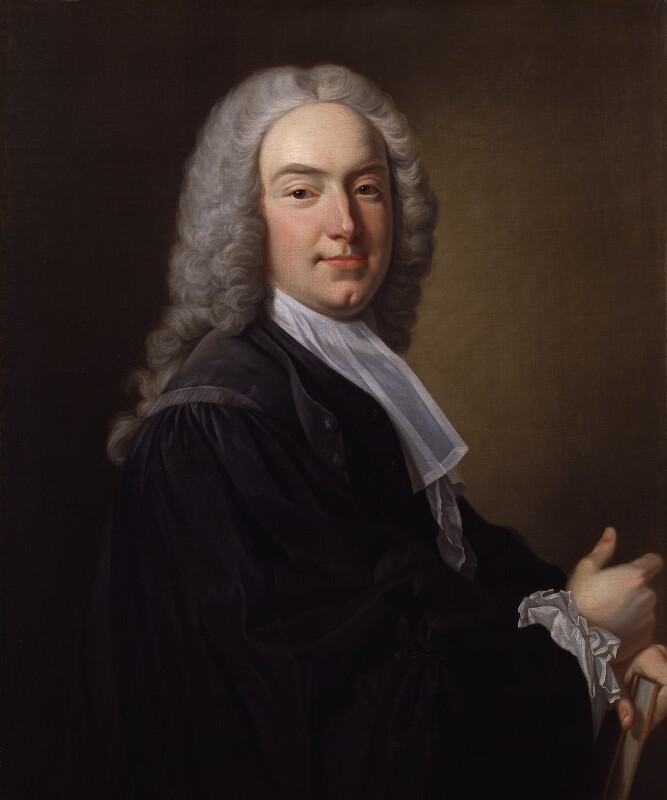
In 1756 William Murray left the House of Commons after 14 years as MP for Boroughbridge, having been appointed Lord Chief Justice of the Court of King’s Bench, and created Lord Mansfield. He was therefore a highly experienced judge by the time he made his ruling in the case of Somerset v Stewart on 22 June 1772. This dealt with the imprisonment of James Somerset, an enslaved person under the ownership of Charles Stewart. Although Mansfield had not wished it to be so, his decision was seen as a judgment on the legal status of slavery in England.
Prior to the Somerset decision, although slavery was rife within the British colonies, the status of slavery in England itself was disputed. Previous high-ranking law officers had left contrary opinions on the matter. In 1696 the Lord Chief Justice Sir John Holt, in the case of Chamberlain v Harvey, had ruled that ‘no man can have property in the person of another while in England’. Yet 23 years later, the West India lobby, opposed to Holt’s previous statement, obtained an unofficial opinion from the Attorney General Philip Yorke and the Solicitor General Charles Talbot:
We are of opinion that a slave, coming from the West Indies to Great Britain or Ireland, with or without his master, doth not become free; and that his master’s property or right in him is not thereby determined or varied; and that baptism doth not bestow freedom upon him, or make any alteration in his temporal condition in these Kingdoms. We are also of opinion that his master may legally compel him to return again to the plantations. – Yorke-Talbot Opinion, 1729


It is with these conflicting statements in mind that we need to understand the significance of the Somerset v Stewart decision.
Charles Stewart (or Steuart), a Scottish merchant who had become a cashier and paymaster of customs in Boston, Massachusetts, came to England on business in 1768/9, bringing with him James Somerset, an enslaved person under his ownership. During their time in England, Somerset was baptised, with three abolitionists – Thomas Walkin, Elizabeth Cade and John Marlow – acting as godparents. As the Yorke-Talbot opinion suggested, there was a belief, which their opinion disagreed with, that the baptism of an enslaved person made them free. Somerset eventually escaped Stewart’s service in October 1771, evading recapture until the end of November. He was taken to a ship anchored in the Thames – the Ann and Mary – and detained there for the purposes of being shipped to Jamaica to be resold as a slave. His godparents intervened, issuing a writ of habeas corpus, a legal procedure under which a prisoner would be brought to court to decide whether they had been lawfully detained. Somerset was duly brought before the Court of King’s Bench on 9 December 1771.
The case eventually began in February 1772, heard by three judges with Mansfield presiding as Lord Chief Justice. Somerset was released pending the hearing, and in that time met with the famed abolitionist Granville Sharp, who had previously issued writs of habeas corpus for similar cases to resolve the uncertainty surrounding slavery. Although he supported Somerset’s case, he did not represent him; Somerset was instead defended by a team of barristers led by the sitting MP for Middlesex, John Glynn.
The defence sought to frame the judgment on the basis that a ruling in favour of Stewart would set a precedent for legalising enslavement across the British Isles. Francis Hargrave, in this his first case, exemplified this position during proceedings, stating that ‘the question is not whether slavery is lawful in the colonies… but whether in England?’ Another main point of contention from the defence, articulated by John Alleyne, was that due to Stewart’s ownership of enslaved people being legalised through municipal law in America, his ownership of James Somerset did not hold sway in ‘a country where such municipal regulations do not subsist.’
The lead counsel for Stewart, John Dunning, who was also a sitting MP, sought to challenge Alleyne’s argument. He posited that although municipal regulations were not binding in a different country, there were relationships similar to Stewart and Somerset’s of an equivalent status that could be transposed: ‘I have not heard, do I fancy, is there any intention to affirm, the relation of master and servant ceases here?’ William Wallace also questioned what the implications of setting Somerset free would be for the lucrative industries in the colonies that were dependent on the labour of enslaved people. He argued that ‘the Court must consider the great detriment to proprietors… that many thousands of pounds would be lost to the owners, by setting them [enslaved persons] free.’
On 14 May, Mansfield adjourned the final session before his judgment was to be given. As in previous cases he had presided over, Mansfield strongly recommended that an agreement between the parties be reached before an opinion was given, but it seemed that both sides were committed to a judicial resolution. Reluctant to give a judgment on the legality of slavery in general, Mansfield narrowed the remit of his judgment. Rather than answering questions on the morality of enslavement, or the potential detriment to British commerce, Mansfield stated that his decision would be based on ‘whether any dominion, authority or coercion can be exercised in this country, on a slave according to American laws?’
The Court of King’s Bench’s decision was finally read by Mansfield in Westminster Hall on 22 June 1772. The Morning Chronicle reported the day after the decision that ‘Lord Mansfield in a written speech, as guarded, cautious, and concise, as it could possibly be drawn up, delivered the unanimous opinion of the whole court…’ Within the parameters he had previously proposed, Mansfield asserted that ‘so high an act of dominion must be recognized by law of the country it is used.’ As the dominion over another person that slavery imposed was not supported by English law, Mansfield declared:
Whatever inconveniences, therefore, may follow from a decision, I cannot say this case is allowed or approved by the law of England.
James Somerset was therefore released.
Although this declaration created a judicial decision against the institution of slavery in England, the parameters Mansfield had set greatly narrowed the impact of Somerset’s release. The precedent set by this case was that the actions of Stewart to detain Somerset against his will to deport and sell him into slavery were not supported by English law. However, this did not outlaw the existence of slavery in the colonies, or the existence of domestic servitude. Rather it stipulated that the level of dominion over another which Stewart had tried to enforce – the forced deportation of an individual for the purpose of selling them as a slave – was unlawful in England.
Despite Mansfield later stating in 1785 that his decision went ‘no further than that the master cannot by force compel him [the slave] to go out of the Kingdom’, this judgment was seen by many as a boon to the emerging abolitionist campaign, posing the question, if slavery in its fullest extent could not be legal in England, why was it still legal in the colonies? With the emergent anti-slavery rhetoric gaining more traction, the West India Interest saw for the first time that there was unified opposition to the status quo. New tactics were needed to counter fears that Somerset v Stewart could eventually destabilise the practice of colonial slavery.
JMPB
Further Reading:
Somerset v Stewart, 1 Lofft 1, 1772
D. Olusoga, Black and British: A Forgotten History (2016)
N. S. Poser, Lord Mansfield: Justice in the Age of Reason (2013)
E. L. Wong, ‘Emancipation after “the Laws of Englishmen”, in Neither Fugitive nor Free: Atlantic Slavery, Freedom Suits, and the Legal Culture of Travel (2009), 19-76
D. J. Hulsebosch, ‘Nothing but Liberty:” Somerset’s Case” and the British Empire’, Law and History Review 24, 3 (2006), 647-657
S. Swaminathan, ‘Developing the West Indian Proslavery Position after the Somerset Decision’, Slavery and Abolition, 24, 3 (2003), 40-60
