

In the latest blog for the Georgian Lords, Dr Stuart Handley charts the history of the Southwell family, from their origins in Gloucestershire and as administrators in Ireland to their ultimate inheritance of one of the senior peerages in the House of Lords.
It is particularly satisfying when the various sections of the History of Parliament allow the fortunes of one family to be traced through time. The Southwell family of Kings Weston, Gloucestershire, can be followed through each section of the House of Commons from 1660-1790 and then the 1715-90 section of the House of Lords.
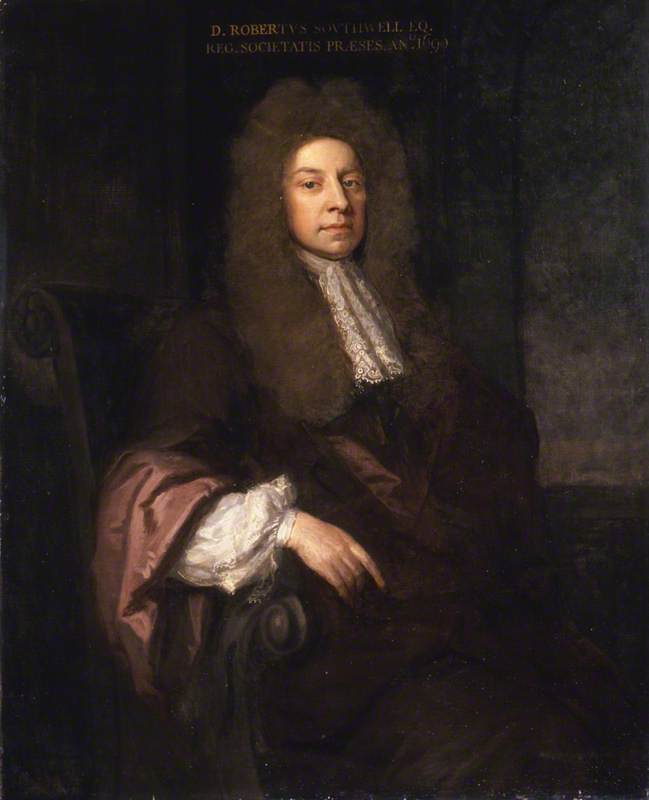
The first member of the family to sit in the Commons was Sir Robert Southwell (1635-1702), who sat for Penryn in Cornwall from 1673-79, and again in 1685. Southwell’s father, also Robert (died 1677) had been involved in administration in Ireland since 1631. Southwell began his public service as a clerk to the privy Council in 1664, and during his career he accumulated many offices in both Ireland and England, and served on numerous diplomatic missions. By 1672 he had purchased a property in Spring Gardens, Westminster, and in 1679 he purchased Kings Weston in Gloucestershire, a place convenient for taking frequent trips to Ireland. He was buried at Henbury, near Kings Weston in 1702.
His son Edward Southwell (1671-1730) succeeded to some of his father’s offices and became an Irish MP in 1692. He served in the Dublin Parliament until his death, either for Kinsale or Trinity College. Shortly after his father’s death he was elected to serve for Rye in the English Parliament. He retained his seat until 1708, and later served for Tregony in Cornwall and Preston in the British Parliament. Andrew Hanham summed him up for the History as ‘a particularly polished example of the class of middling administrators who, though having no particular aspiration to the highest bureaucratic offices, nevertheless served with exemplary skill and industry.’ [House of Commons, 1690-1715, v. 528].

His son, Edward Southwell (1705-1755) was an Irish MP for Downpatrick 1727-1755 and served for Bristol 1739-54. He was more of a sinecurist, but made a step-up in the marriage stakes, his bride being the daughter of Edward Watson, Viscount Sondes, and the sister of the 2nd and 3rd earls of Rockingham.
His son Edward Southwell (1738-1777) sat for Kinsale in the Irish parliament (1761-8), and Bridgwater 1761-63 and Gloucestershire 1763-76. Interestingly, he took office as steward of the manor of East Hendred, which allowed him to relinquish his seat and stand successfully for the county. The death on 28 February 1775 of Margaret Tufton, one of the coheirs of Thomas Tufton, 6th earl of Thanet, countess of Leicester by marriage, and suo jure Baroness de Clifford, raised the prospect that Southwell would again have to relinquish his seat, upon elevation to the House of Lords. There were several claimants to the title, which took some time to resolve, although George III quickly went to the nub of the question when he told Lord North that:
“the Earl of Salisbury and Lady Egmont having for their families seats in the House of Lords are out of the question, the decision must lie between Mr. Southwell and the dowager countess of Gower, the former being descended from the eldest sister and having an estate sufficient to support the dignity seems to have a prior claim to favour.”
[Correspondence of George III, ed. Fortescue, iii. 183, George III to North, 28 February 1775]
After due consideration, Southwell was summoned by writ on 17 April 1776 and took his seat as 20th Baron de Clifford on 24 April. His short tenure of a seat in the Lords was ended when he died in France on 1 November 1777. His widow was to become the governess to Princess Charlotte of Wales, the only child of the future George IV.
His son, Edward Southwell (1767-1832), succeeded as 21st Baron de Clifford, taking his seat on 21 April 1789 and last attending in 1831. He was succeeded by his niece Sophia Coussmaker (1791-1874) as 22nd Baroness de Clifford, wife of John Russell, a nephew of the 6th duke of Bedford.
SNH
Further reading
The House of Commons 1660-1690, ed. B.D. Henning (1983)
The House of Commons 1690-1715, ed. E.C. Cruickshanks, S.N. Handley and D.W. Hayton (2002)
The House of Commons 1715-1754, ed. R. Sedgwick (1970)
The House of Commons 1754-1790, ed. L.B. Namier and J. Brooke (1964)
The House of Lords 1715-1790, ed. R.D.E. Eagles (forthcoming)
