

In today’s blog for the Georgian Elections Project, Dr Kendra Packham (Institute of English Studies, University of London and Newcastle University) tells us about her research on eighteenth-century election ballads, and finds in the forgotten election ‘chairing’ song points of comparison with the campaign for the 2024 UK general election.
In the eighteenth century, when the ability and opportunity to vote was heavily restricted, songs and music were a key aspect of election campaigns and the political process.
Songs and music accompanied, and were an important part of, the kind of election events satirically depicted by Hogarth, from election ‘entertainments’ to the polling. Competing campaigns used the memorable and emotive power of music and verse to appeal to voters, and wider opinion. Election agents and committees paid for the printing and distribution of partisan election ballads, set to well-known tunes, such as ‘Chevy Chase’, and ‘God Save the King’. Voting often took place over a number of days, and rapidly printed ballads could also appear during the course of the poll in a bid to influence events. A note on a Somerset ballad of 1768 stated that it was ‘dispersed by the agents’ of one of the candidates, while, in Lincoln in 1823, it was reported that copies of a satirical election song were ‘scattered in great profusion’ from the windows of an inn during polling.
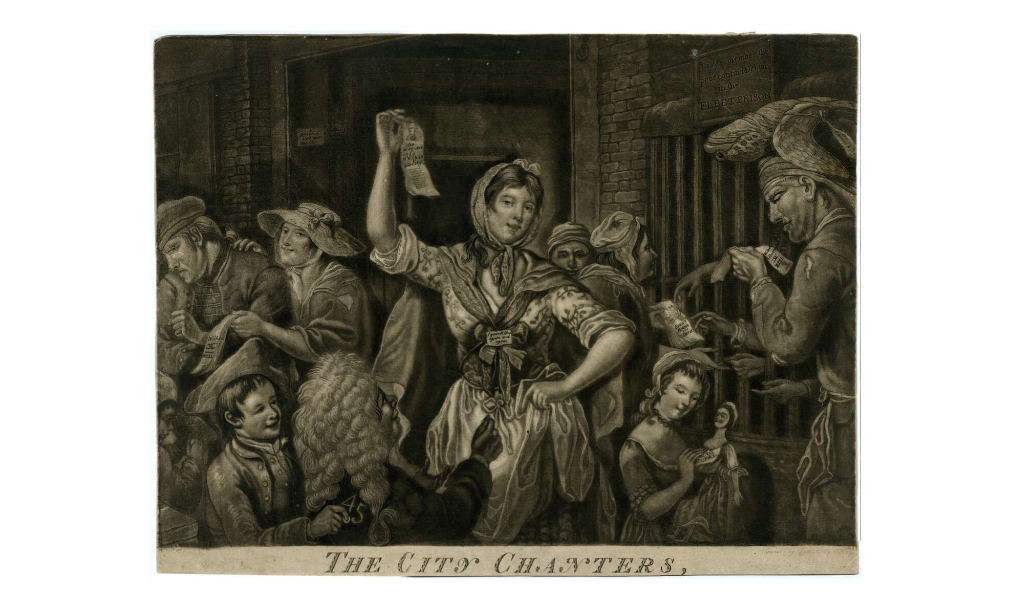
Ballad singers were also paid to sing election ballads in the vicinity of the polling place: this happened so frequently that Frederick Pilon’s 1780 play on the ‘humours’ of an election included a scene in which a ballad singer sings voting advice to ‘crowds of people’ gathered at the hustings. Similar figures appear in satirical prints, such as one on the 1780 Westminster election, showing a man standing on a barrel in front of the hustings, singing a ballad to the tune ‘Derry Down’.

As well as celebrating and attacking particular candidates and parties, election ballads could instruct on the practicalities of voting – for example, by encouraging people to meet at a certain place in order to go to vote. Ballads could also promote eighteenth-century versions of tactical voting, including encouraging voters only to use one of the two votes they were allowed, to avoid helping other candidates (‘plumping’). It was claimed that particular ballads had an effect on the outcome of an election, including in Yorkshire in 1784, and Coventry in 1826. There is also plenty of evidence for songs and music being used in the campaigns of those who weren’t elected.
Election ballads also impacted elections more broadly. They were read and performed in a wide variety of settings – including inns, polling places, and in the streets – where they fuelled the political engagement of voters and non-voters who heard, sung, read, and danced to them. By encouraging interest in, and opinion about political issues and the political process across the social spectrum, ballads contributed to a wider ‘culture’ of elections and electioneering in the era before democracy.
© The Trustees of the British Museum
Certain songs particularly caught the public imagination and became vehicles for political expression and protest. One of these was Handel’s famous chorus, ‘See, the Conqu’ring Hero Comes!’ (from his oratorios Joshua and Judas Maccabaeus). Indeed, Handel reportedly foresaw the piece’s great popularity. Moving from the theatre to the street, the chorus was regularly performed during election ‘chairings’. This was when victorious candidates – or temporarily or would-be victorious candidates – were seated in decorated chairs and carried, typically through major streets, often accompanied by banners, flags, and musicians playing drums, trumpets, and fifes. Such processions could be attended by many thousands, gathered in the streets and watching from windows – including women, children, and men who didn’t have the vote. The ceremony is famously satirized in Hogarth’s Chairing the Member, in which the member is about to be toppled by unruly bearers.

The songs and music that accompanied chairings often used martial tunes to figure electoral victory as a form of military triumph, and could also be played by military bands. The words to Handel’s chorus were well suited to this ‘heroic’ fashioning: ‘See, the conqu’ring hero comes! / Sound the trumpets, beat the drums!’. At the Wiltshire by-election of 1819, John Benett’s triumphal procession through Salisbury featured banners with the words ‘See, the conquering hero comes’ and it was reported that, as soon as the band ‘struck up’ the accompanying tune, ‘the multitude joined in the chorus’.

Handel’s chorus was also adapted to address particular political circumstances. Electoral adaptations of Handel could be printed and circulated as broadsides and slip songs; one song printed after the turbulent Coventry contest of 1784 reworked Handel to comment on perceived ‘illegal’ proceedings during the election, and assert the legitimacy of the result. This song called on its audience to ‘See the legal members come, / Sound your fifes and beat the drum’.
As well as being used by the ‘winning side’ to assert the legality of their victory and expose perceived electoral abuses, chairing songs could also be used to challenge a result. Although often thought of as taking place at the end of an election, chairings could also take place at various other points in the campaign (and repeatedly during the electoral process), and they could serve the rhetorical function of willing, or asserting, a victory that had yet to be – and perhaps was unlikely ever to be – officially confirmed. Chairing songs could circulate and be performed during a campaign as a means to dishearten an opponent, and were also enlisted in post-election challenges, by celebrating those seen (at least by some) as the ‘true’, if unofficial, victors.
In the Worcester election of 1774, when Sir Watkin Lewes finished in third place, it was reported that he immediately ‘protested against the return’ on the grounds of ‘illegal’, ‘unjust’, and ‘corrupt’ proceedings, and declared his intention to challenge the result in Parliament. It was also reported that, as soon as he left the polling place, Lewes was ‘chaired’ and ‘carried through the principal streets, amidst the acclamations of a vast concourse of people, singing their favourite song, “See the legal member come”’.
Lewes’ own protest was amplified by a general chorus of disapproval against perceived electoral injustice: a protest also publicized more widely through newspaper reporting of the incident. (And this episode suggests how the later Coventry song hailing the ‘legal members’ belongs to wider political and musical tradition.) When sung at chairings, songs not only had the potential to reach a large audience (if they could be heard above the noise). They could also be a way to involve this audience in a form of active, very public and collective political expression, by getting them to sing together, and making them performers. (It is important to remember that chairing songs could also be used ironically, and could be provocative, and produce different responses, including jeering and parody.)
The performance of these ‘victory songs’ during elections in the eighteenth century can perhaps invite some comparison with the playing and singing of ‘Things Can Only Get Better’, a song associated with a previous Labour victory, during the speech in which Conservative Prime Minister Rishi Sunak announced the date of the 2024 UK general election. While the playing of this piece during the Prime Minister’s speech had a range of different effects on different audiences, like the chairing songs of the past, it brought to the fore the use of political and musical memory – and the songs and music of victory – to engage with a current election.
KP
Further Reading
Kendra Packham, ‘Literature and the Culture of Elections and Electioneering in Eighteenth-Century England’, The Review of English Studies, 72 (2020), pp. 104–28.
T. W. Whitley, The Parliamentary Representation of the City of Coventry (Coventry, 1894).
