

As the results of the 2024 General Election start to come in, successful candidates will have different ways to celebrate their win- but it is unlikely that these newly-elected MPs will be hoisted in the air in a traditional ‘chairing’ ceremony… In the latest blog for our Georgian elections project Dr Robin Eagles looks at this tradition and some of the 18th century constituencies that may have taken it too far.
One of the most iconic images from an 18th-century election was the successful candidate being chaired through the town by a jubilant set of supporters. Possibly the best known image is that by William Hogarth at the conclusion of his series, the Humours of an Election. In it a rotund candidate (normally identified as George Bubb Dodington) struggles to keep his seat as his chair is carried through a rioting throng of supporters and opposition activists. As the ECPPEC project has shown, the chairs used in this ceremony were rarely preserved, so few examples remain. This is perhaps the less surprising when we consider how lively (for which read raucous) the ceremony might be, as is clearly indicated both in images like that by Hogarth and from examining a series of newspaper reports from the period.
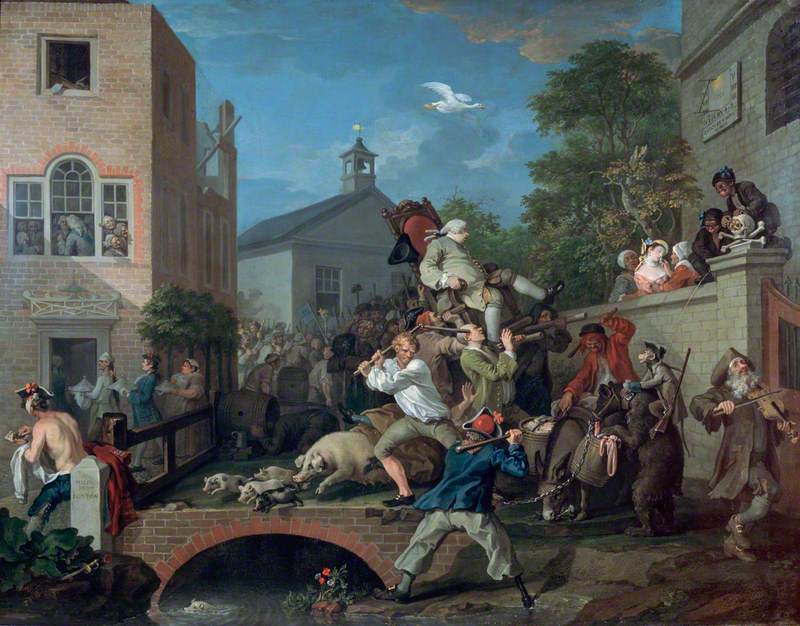
William Hogarth;
Sir John Soane’s Museum via ArtUk
The general election of 1734 was dominated by the aftermath of Sir Robert Walpole’s failed effort to pass the Excise the previous year and this was reflected in many of the individual polls. In May 1734, the poll for Derbyshire concluded with Lord Charles Cavendish and Sir Nathaniel Curzon, bt. ahead of the third-placed candidate, Henry Harpur. Cavendish and Curzon’s success infuriated Harpur’s supporters and the press reported how ‘an outrageous Mob’ gathered in front of County Hall to prevent Cavendish from being chaired. Their action resulted in skirmishes between the rival camps which left at least one man dead, several more wounded and a great number of smashed windows. Consequently, Cavendish and Curzon’s chairing was delayed to the following day. [Daily Courant, 28 May 1734]
Derbyshire’s unruly chairing was in striking contrast to that at York, even though the contest had been ‘hard fought’ and there were later to be unsuccessful petitions against the result. Here Sir Miles Stapleton, a Tory backed by some opposition Whigs, was elected for the county, and was carried around the city in triumph, with flags and ensigns carried before him. According to one paper the event ‘was attended by the greatest number of gentlemen, as well as the populace, that ever was known’ in the city. Stapleton gave a ball the same night and there was ‘nothing but rejoicings in the City, (except a few)’. Even such an apparently joyful occasion, though, was too much for the other successful candidate, the Whig Cholmley Turner, who pleaded indisposition through gout, and so passed on being carried around at the same time. [Daily Journal, 7 June 1734]
Three decades on and the country faced an even more charged general election than that of 1734 prompted by a difficult economic situation, widespread unemployment, the presence of numerous carpet-bagger candidates, and chief among them, the return from exile of the divisive figure of John Wilkes. Wilkes’s attempt to secure election in the City of London proved unsuccessful, but he was returned at the head of the poll for Middlesex instead. Even so, Wilkes clearly decided that for once he ought to show some restraint and in spite of efforts to persuade him to be chaired around Brentford, ‘he absolutely refused, choosing to retire with the greatest privacy’. [Public Advertiser, 1 Apr. 1768] His victory inspired celebrations beyond the bounds of his own constituency, though, and in Edinburgh it was reported that a large number of apprentice boys paraded around with an effigy of Wilkes on their shoulders, which they later chaired before committing their ‘mock hero’ to a bonfire erected at the Grass Market. [Lloyd’s Evening Post, 8-11 April 1768]
RDEE
Find out more about the chairing process via our friends at ECPPEC, or read more about 18th century elections through our Georgian Elections Project.
