

You may have heard of Catherine Despard from the television series Poldark. In this blog Helen Wilson, PhD candidate with the History of Parliament and Open University, who is researching the Black and Mixed Ethnicity Presence in British Politics, 1750-1850, discusses Catherine’s marriage to Edward Despard and their status as an interracial couple involved in radical campaigns.
The Despard conspiracy occurred in early 1802 and was led by Colonel Edward Marcus Despard (1751-1803), an Irish army officer and Catherine’s husband. They had met possibly in Jamaica or while Edward was stationed at the Bay of Honduras (now Belize), where he fought in the Spanish Main. During this period, Edward became an elected administrator in Belize. Still, he became highly unpopular with the mahogany loggers and enslavers because he instituted a land lottery to distribute the land fairly. In Jamaica, he was an engineer responsible for infrastructure works. He fought in Nicaragua alongside Nelson and then administered in Belize. In all these places and through their experiences, he fostered a genuine empathy and commonality across race, class and gender. Catherine’s story is less well-known. Her mother’s will has been identified, confirming she was born in Jamaica. Her mother, Sarah Gordon of St Andrew’s Parish, a free Black woman, died on 25th Jul. 1799.

Catherine and Edward’s marriage does not appear in the records in any of the parishes in Jamaica, indicating either that they were married in Belize or were not officially married. However, throughout their time in England, only Edward’s family struggled with them being married, writing both Catherine and their son John Edward Despard (c.1780-1836) out of the family tree. Catherine was, however, repeatedly referred to as his wife in newspapers, letters and by their friends. Catherine’s story is indelibly tied to Edward’s. Edward was called to London because of complaints about his land lottery. The system did not recognise race or class when dividing land rights; this did not favour the Baymen (mahogany loggers who owned enslaved peoples). The Baymen were angry that they were seen in common with the “lowest mulatto or free negro”. Edward kept land in common ownership and tried to keep food prices low so that poor people could buy it. In 1790, Lord Grenville recalled Edward to London, and he, Catherine and their son sailed for England.

The Despards arrived in London in 1790, and Edward attempted to settle his dispute with the Government over what he saw as his unfair dismissal. He believed that he was deserving of compensation for unpaid earnings. The Government disagreed. This conflict took two years to resolve and ended with Edward not being charged or receiving any payment. Meanwhile, he was pursued with lawsuits by the Baymen and spent two years in debtor’s prison (1792-4). In 1795, Edward was again arrested for referring to himself by the title citizen when a police constable stopped him at a riot in Charring Cross, one of many forms of protest seen during the summer of 1795. There had been instances of crowds gathering outside Downing Street or surrounding the King in procession to parliament. The riot in Charing Cross was an extension of this unrest, and by October, the Government introduced the Seditious Meetings Act and the Treason Act. Edward was politically active and was seen as a threat by the Government. He was a member of the London Corresponding Society (LCS), a federation of reading and debating clubs that agitated for democratic reform of parliament by petitions and demonstrations. He was a prominent figure in discussions held in 1797 involving plans for a French-supported rebellion in Ireland. He was involved in radical groups, including LSC, the United Irishmen and the United Britons. Catherine’s role in these schemes is unknown. The LCS does not appear to have had female members, but it did support Women’s meetings, and women attended their demonstrations. However, from her closeness to Edward throughout his multiple incarcerations and her fervent advocation for his improved treatment, it may be fair to assume that she at least supported her husband’s actions and beliefs. The plot for which he was imprisoned for the final time was regicide. The aim was to have George III’s carriage fired upon by a stationary cannon while on its way to Buckingham House (Palace). Once the King had been assassinated, the plotters would seize the Bank of England and incite a military rising of the Third Grenadiers stationed at the Tower of London. Edward was arrested in 1802, and his execution occurred on 21st February 1803.
Catherine and Edward were staunch abolitionists; they advocated for the working class and common land not to be enclosed. When Catherine arrived in London, Europe was in a state of fomenting unrest and radical politics. London’s Black population was not exclusively made up of servants and service members. It is clear from her letters that Catherine was educated. Her fluent, thorough, persistent style and beautiful penmanship exude a well-read and confident communicator. At the gallows, Edward’s final words, delivered to a crowd estimated to have amounted to 20,000 people, were a collaboration between them. She had been back and forth for days, helping him write his speech, his petitions for mercy and carrying papers. Famously, Sir Richard Ford, the Chief Magistrate of London, wrote to Lord Pelham, Home Secretary, on the night of the execution, said of her, “Mrs Despard has been very troublesome, but at last she has gone away.” Catherine had launched a campaign advocating for better treatment of her husband and his fellow inmates beginning in 1798. Her activism incited a debate in the House of Commons about the suspension of Habeas Corpus, in which MP John Courtney read one of her letters in the chamber. Catherine wrote to Sir Francis Burdett, MP, who was known for his opposition to war and political prosecutions. Eliciting the support of influential politicians shows political shrewdness and an understanding of political power.
The gallows speech expresses a deep concern for the principles of equality. They use the rhetorical device of threes; he stated, “[I] served my country faithfully, honourably and usefully”. This echoes the cry of the French Revolution liberté, égalité and fraternité. They use the address’ citizen’, intended to strip away hierarchical titles such as Sir, My Lord and My Lady. This term was already internationally recognised within radical speech as expressing affiliation with the Revolution and the collective humanity of all people. The sheriff threatened to stop Edward’s speech at the use of the phrase ‘Human Race’ because it was deemed too inflammatory. Edward and Catherine’s perception of the human race differed from what was being established politically and scientifically: a strict hierarchy between races and classes.

The late eighteenth century was a politically turbulent period. There was political unrest in Britain from radicals who sought democratic reform, republicans who called for the end of the monarchy, abolitionists who fought for the end of the slave trade and emancipation of the enslaved, and loyalists to either the King or parliament. The continuing wars strained the British economy, which helped create discontent within the general population. Catherine was part of a political milieu that included the abolitionists Olaudah Equiano (c.1745-1797) and Ottobah Cugoano (c.1757-1791), the radical author Henry Redhead Yorke (1772-1813), Cato Street conspiracist William Davidson (1786-1820) and the radical preacher Robert Wedderburn (1762-1835/6). Catherine could not gain her husband’s freedom, but she was disruptive. She did not stay in her place and play the forlorn wife; she instead campaigned, wrote and organised.
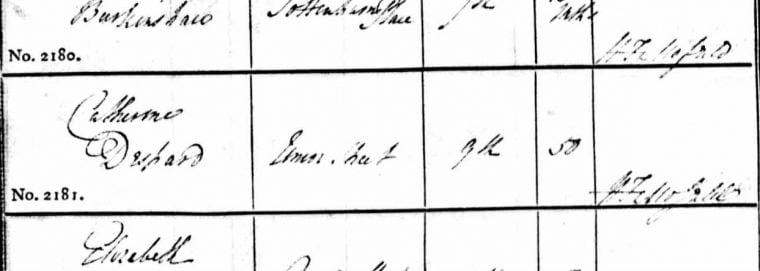
HW
Conner, Clifford D. Colonel Despard: the Life and Times of an Anglo-Irish Rebel. Pennsylvania: Combined. 2000
“EXECUTION OF COLONEL DESPARD, ….” Morning Post, 22nd Feb. 1803. British Library Newspapers.
Gerzina, Gretchen. Black London: Life before Emancipation. New Brunswick: Rutgers University Press. 1995.
Gillis, Bernadette M.’ A Caribbean Coupling Beyond Black and White: The Interracial Marriage of Catherine and Edward Marcus Despard and Its Implications for British Views on Race, Class and Gender during the Age of Reform.’ Masters, Duke University, 2014.
Jay, Mike. The Unfortunate Colonel Despard. London: Bantam Press, 2004.
Linebaugh, Peter. Red Round Globe Hot Burning: A Tale at the Crossroads of Commons and Closure, of Love and Terror, of Race and Class, and of Kate and Ned Despard. University of California Press, 2019.
Linebaugh, Peter, and Marcus Rediker. The Many-Headed Hydra: Sailors, Slaves, Commoners, and the Hidden History of the Revolutionary Atlantic. Boston: Beacon Press, 2000.
The National Archives of the UK (TNA), Home Office (HO) 42/43/127. Folios 291-293. 1798.
