

Continuing our series reflecting on the Organise! Organise! Organise! conference hosted by Durham University and supported by the History of Parliament, guest blogger Erin Geraghty, Teaching Associate at the University of Nottingham, shares her thoughts on the fresh perspectives offered on British and Irish political history.
In July, Durham University hosted ‘Organise! Organise! Organise! Collective Action, Associational Culture and the Politics of Organisation in Britain and Ireland c.1790-1914’. This event was the first conference entirely dedicated to exploring political organising in the modern British Isles. Over the course of two days, attendees were treated to a range of papers that not only focused on how politicians ‘did’ politics, but also explored the thoughts and experiences of people involved in, or affected by, politics. The conference provided a fresh perspective on political history, viewing politics through the lens of emotions, language, space and geography, gender and sexuality, and material culture. This multi-dimensional snapshot of political history felt engaging and innovative, leaving newcomers like myself excited by the depth and breadth of the field.
Professor Katrina Navickas opened the conference with an excellent keynote lecture which defined politics and political organising:
Politics is about meetings. Politics is about petitions. Politics is about committees. Politics is representing the locality to the nation. Politics is about claiming representation as part of the locality. Politics is claiming public space for ‘the right of free speech’.
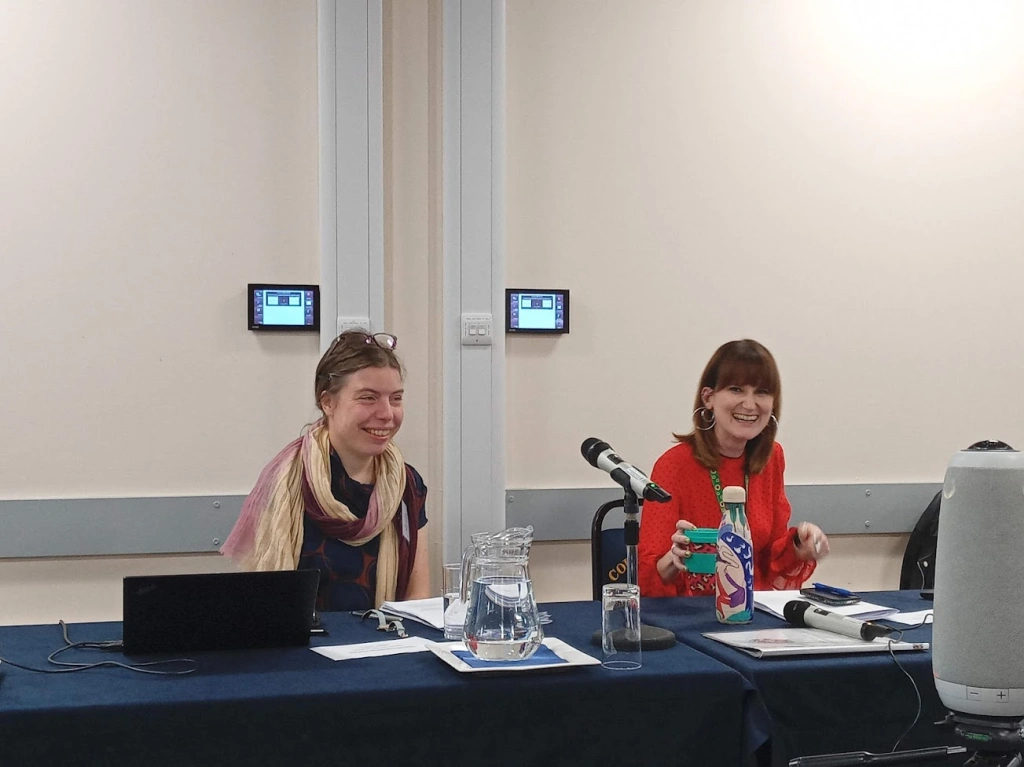
As well as providing an overview of ‘new’ and ‘traditional’ political history and setting the tone for the rest of the conference, Professor Navickas contributed new research on geographies of political protest and the contested nature of the public political arena. She outlined the battles over locality and place in nineteenth-century British politics, a topic revisited later in the conference by historians such as Dr Dave Steele with his paper on crowds at Peterloo in 1819 and Kennington in 1848, and Dr Mari Takayanagi with her work on the contested and gendered space of parliament (based on her recent book, Necessary Women: The Untold Story of Parliament’s Working Women, 2023).
Many of the papers focused on England as the metropole of Empire and political life in the British Isles; however, Wales and Ireland, and to a lesser extent, Scotland, were well-represented at this conference. Furthermore, a panel entitled ‘Politics of Empire’ helped provide the important global and postcolonial aspect to this political history conference. The panel ‘Politics in Ireland’ considered Unionism in Victorian Belfast as well as the possibility of a ‘frontier mentality’ in south Ulster in the early nineteenth century. Dr Niall Whelehan’s paper on the activities of the Irish Ladies Land League contributed to an understanding of Irish activism against landlordism in both Britain and Ireland in the late nineteenth century. Similarly, my own paper on the relationship between Irish and British suffragettes in the immediate pre-First World War period examined the tensions around gendered political organising across the Anglo-Irish border prior to Irish independence.
There was a plethora of papers that considered radicalism, political organising and counter-organising in Wales. Dr Shaun Evans’s paper on landowners and land reform in North Wales examined the activities of the North Wales Property Defence Association, exemplifying the reaction to growing radicalism in late nineteenth century Wales. Dr Marion Löffler explained how poetry and song were used in the 1790s by radicals as an act of political dissent and resistance. Dr Martin Wright spoke on the tensions between Welsh nationalism and language revival and socialism in pre-First World War Wales. Dr Wright explained how the use of Welsh as the language of politics in Wales had its last hurrah in the final decades of the nineteenth century – by the beginning of the twentieth century, the language of socialism was thought to be English.
My favourite panel of the conference was ‘Politics of Emotions’, which set out the importance of tracing emotions in political history, both by those doing politics, and those experiencing it. Dr Laura Forster’s paper focused on socialist organising and idea-formulation outside of formal political spaces, and the extent to which conversions to socialism were prompted by an emotional experience rather than reading of theoretical works. This was juxtaposed against Nicholas Barone’s work on apathy in British radical politics in the late eighteenth and early nineteenth century and Professor Matthew Roberts’s work on how Richard Cobden and Robert Peel used heightened political feelings as a parliamentary tool. In the last ten years, the history of emotions has developed into a wide-ranging and productive field of historical research, and it was really exciting to see emotions brought into the history of politics through the three papers on this panel.
The conference was structured with two panels occurring simultaneously, which spoke to the breadth and interest in this historical discipline. It was often difficult to choose which panel to listen to; however, I found that tea-break conversations often filled in what had been missed over in the other room. There was a shared acknowledgement that it was good to meet in person again after the pandemic years. For Early Career Researchers like myself, this was an especially useful opportunity to network and share ideas with historians in the field. I enjoyed the sense of community that was fostered during the conference. The Organise! Conference blended the traditional in-person event with the modern virtual gathering, making it a truly hybrid experience. This amalgamation brought together the best of both worlds and allowed for broader participation. I am pleased that the concept of hybridity continues to thrive as a positive legacy of the challenging pandemic period.
Throughout the conference, I was struck by the timeliness of many issues the papers dealt with. For example, Dr Kate Connolly’s paper on the East End People’s Army and the police brutality faced by suffragettes in the East End of London was prefaced by the point that the police are currently under scrutiny for their undercover policing practices today, prompted by the recently published interim report. Dr Connolly made the pertinent point that analysis of historical precedent can provide us with tools to understand contemporary events. Similarly, papers delivered by Dr Forster and Dr Wright prompted important conversations about socialist political organising outside formal spaces and the emotional aspect to socialist conversions. History of political organising and mobilisation in the age of association informs our understanding of, and participation in, politics today.
E.G.
Erin Geraghty is a Teaching Associate in Modern Women’s History at the University of Nottingham. Her research focuses on the intersections between early feminism, imperialism, socialism, and internationalism in Britain and Ireland in the first few decades of the twentieth century.
