

During the 1993 Labour Party Conference, all-women shortlists were endorsed by the party. In the following general election in 1997, the number of women MPs doubled. In this blog, Alfie Steer explores our oral history archive and discusses the controversy of AWS and its impact on Parliament.
This year marks thirty years since the Labour Party first introduced all-women’s shortlists (AWS) for parliamentary selections. Its introduction was controversial, both then and now. But by the time the dust had settled on New Labour’s 1997 election landslide, it had transformed the makeup of the House of Commons. Women MPs, once a tiny minority, were suddenly a sizeable, and noticeable presence. Their number soared from 60 in 1992, to 120 in 1997. Of that number, 101 were Labour MPs. According to Meg Russell ‘nothing was more symbolic of the party’s “newness”’ than the ‘massed ranks’ of new women MPs. Some even hoped that such an influx would constitute a ‘critical mass’, that would transform both the political priorities and internal culture of the male-dominated Westminster system. While the results have proven more complex, it is undeniable that AWS facilitated a historic breakthrough for women’s representation in parliament.
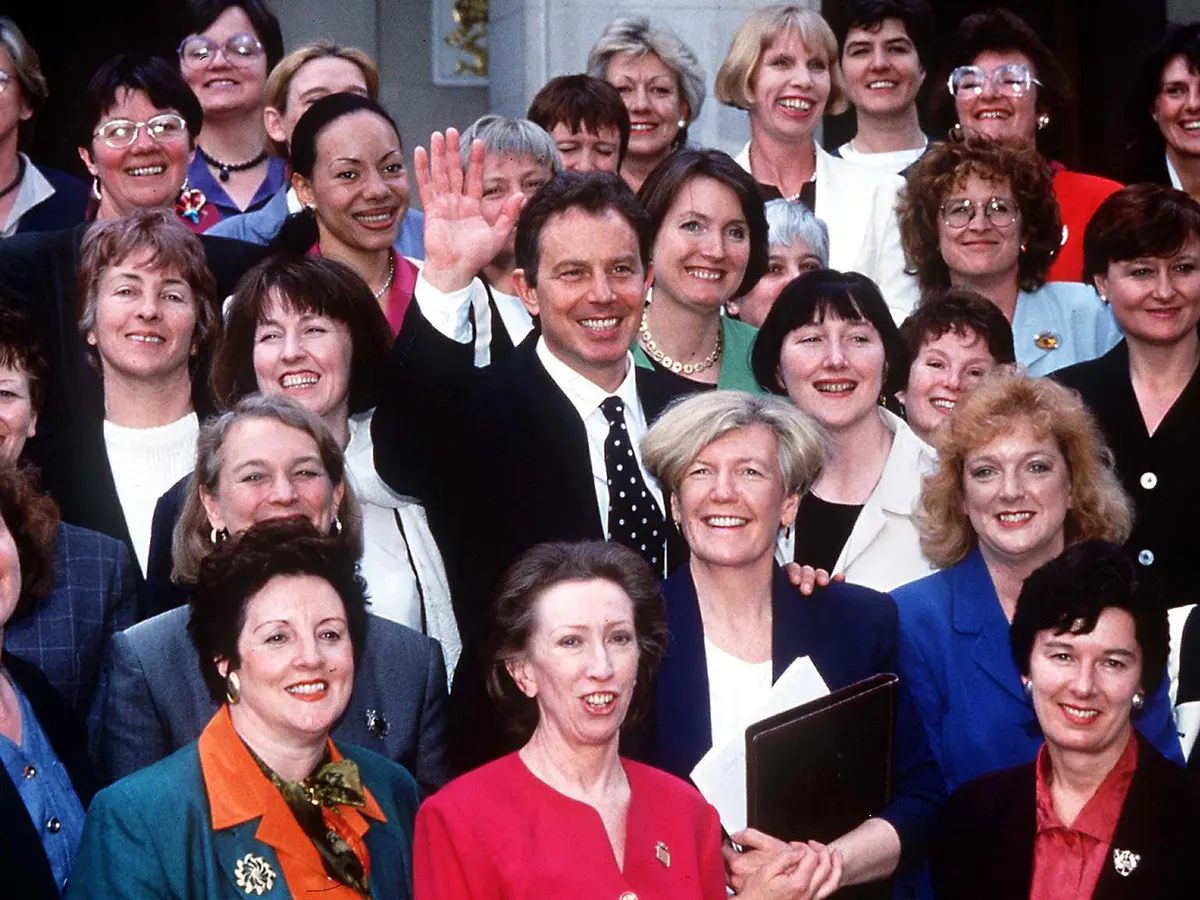
Women MPs were a remarkable rarity throughout the twentieth century. Besides a handful of women, the House of Commons was a space dominated by men. This was sometimes noticed by men themselves, as Bruce Grocott remembered:
All-women shortlists therefore offered the opportunity to redress a profound gender imbalance. The mechanism itself was the result of a long and complicated campaign, led by feminist groups such as the Women’s Action Committee and Emily’s List. Their aim was to strengthen the representation of women and ensure gender equality within the party ‘from top to bottom’ (Helen Jackson, Labour). While the campaign had grown throughout the 1980s, it faced opposition from the party leadership. Numbers of women MPs remained low, which radicalised demands by the 1990s. A system of at least one woman on every shortlist proved ineffective and was replaced with a demand for women-only shortlists.
Eventually, the influence of these campaigns, and the twin shocks of electoral defeat and fundamental changes to the nation’s workforce motivated Labour leader John Smith to finally support AWS. But even then, its introduction was far from straightforward. AWS only came about as part of a complex package of internal reforms around the system of ‘One Member One Vote’ in selections. The block votes of trade union delegations at the 1993 party conference proved crucial. Hilary Armstrong explained in her interview how the AWS was introduced as part of these reforms, and the negotiations that took place with trade unions.
While complicated negotiations, and some degree of wheeling-and-dealing, played a key role in ensuring AWS was endorsed at Labour’s party conference in 1993, Armstrong was also clear that the explicit support of the party’s leader played a crucial role.

Throughout our oral history collection, the attitudes to AWS are diverse. Some women MPs were unfazed by being surrounded by men (Llin Golding, Labour), while others only became supporters of AWS upon hearing of other women’s negative experiences. Sylvia Heal, for example, underwent a major change of view on the issue.
Perhaps unsurprisingly, many did not support AWS. While Linda Gilroy experienced ‘very modest’ opposition to AWS in her constituency, things were far more fraught elsewhere. Ann Cryer described how in her constituency; the issue of AWS divided the local party.
In 1995 two male Labour activists took legal action against the party on the grounds of sex discrimination. Ann Cryer described her memories of the case and the anxieties it caused for women already selected under the AWS mechanism.
The success of the legal challenge meant that all-women shortlists were suspended for the 2001 general election. When the number of women MPs once again decreased, the New Labour government introduced the Sexual Discrimination (Election Candidates) Act (2002) which specifically allowed positive discrimination for election candidates. All-women shortlists returned for the 2005 election.
While the legal challenge frustrated the progress of AWS, it obviously did not stop the significant change in parliament’s make-up by 1997. Nevertheless, some women still expressed reservations about AWS. Some feared it would lead to assumptions that women candidates were not on ‘equal terms’ with men, and could only get ahead through preferential treatment (Ann Taylor and Helene Hayman, Labour). Meanwhile, the press’ infamous labelling of the new intake as ‘Blair’s Babes’ further indicated the obstacles female politicians would continue to face. Unsurprisingly, the infamous ‘Blair’s Babes’ nickname was frequently described by our interviewees as patronising and misogynistic (Eileen Gordon, Labour).
Some women MPs who had fought hard for greater female representation were ultimately dissatisfied with the 1997 intake. Mildred Gordon frankly considered them ‘the wrong sort of women’, being mostly middle-class, professional politicians. Ann Cryer described similar concerns over ‘the shoulder-pad brigade’ of professional women ‘coming up from London’ to impose themselves on her constituency. During the controversial vote to cut lone parent benefits in 1997, a measure that was thought to disproportionately affect women, Maria Fyfe expressed her dismay that many of the new women MPs did not vote against it. Alongside these feminist critiques, the tabloid media would also often portray the 1997 intake as uniquely quiescent toward the party leadership. Yet as recognised by Joni Lovenduski and Pippa Norris, high levels of party discipline placed significant constraints on MPs of all parties (and genders), and as such these criticisms were not always proportionate, and often had gendered undertones.
AWS’s introduction and impact has therefore been a great source of controversy in our oral history collection. As a result, historians should be careful not to mark its thirty-year anniversary completely uncritically. What cannot be denied, however, is how transformative it was on the make-up of the House of Commons, and on the lives of many women. As a result of it, hundreds of women enjoyed long political careers that could otherwise have been severely limited. Ann Cryer, just one example of many, went from collecting membership subscriptions and ‘organis[ing] jumble sales’ to being a parliamentary candidate, and soon after, a Member of Parliament.
A.S.
Download ALT text for all audio clips here.
Further reading:
Joni Lovenduski, ‘Gender Politics: A Breakthrough for Women?’, Parliamentary Affairs 50 (1997), pp.708-719.
Joni Lovenduski and Pippa Norris, ‘Westminster Women: the politics of Presence’, Political Studies 51 (2003), pp.84-102.
Emma Peplow and Priscila Privatto, The Political Lives of Postwar MPs: An Oral History of Parliament (London: Bloomsbury, 2020).
Meg Russell, Building New Labour: The Politics of Party Organisation (Basingstoke: Palgrave MacMillan, 2005).
Clare Short, ‘Women and the Labour Party’, Parliamentary Affairs 49 (1996), pp.17-25.
Find more voices of our archive on the British Library.
Find more blogs from our oral history project here.
Alfie Steer is a historian of modern and contemporary Britain, currently studying for a DPhil at the University of Oxford. His research focuses on the history of the Labour Left from the end of the miners strike to Jeremy Corbyn’s election as Labour leader in 2015. His most recent article was published in Contemporary British History, and has written book reviews for Twentieth Century British History and the English Historical Review. Outside of academia he has written for popular publications such as Tribune.
