
In a series of two blogs, our Public Engagement Assistant, Kirsty O’Rourke, will discuss the 20th century history of Sinn Féin. In this first blog, Kirsty looks at the origins of the party and its founder, Arthur Griffith.
Throughout the 20th century, the Sinn Féin party (translated as we ourselves) underwent multiple changes and divisions. Between its formal founding of 1905 (Sinn Féin was not an official party until 1907) to the election of Gerry Adams as president in 1983, there were several Sinn Féin parties. While the name and symbols remained the same, the form and factions of the party showed discontinuity. The history of Sinn Féin is, therefore, a history of change and factions, and the modern-day Sinn Féin looks very different from its origins.
Arthur Griffith is generally regarded as having founded the party on 28 November 1905, when he presented the Sinn Féin policy at the first annual convention of the National Council, an organisation Griffith created to campaign against King Edward VII’s visit to Ireland in 1903. Among the policies he outlined was a system of dual monarchy, which would mean that Ireland and Great Britain would have two separate governments but be ruled by the same monarch. This was a policy that Griffith had studied at length, including in his book The Resurrection of Hungary: A Parallel for Ireland (1904), which discussed the dual monarchy of Austria and Hungary as a possible model for Ireland.

Before 1905, Griffith had founded and edited the Irish nationalist newspaper The United Irishman, and this was where he first put forward the ideas of the future Sinn Féin party. In 1900, he had called for an association that brought disparate Irish nationalist groups together, and as a result, later that same year, Griffith and William Rooney founded Cumann na nGaedheal (translated as Society of the Gaels). Significantly, during the 1902 Cumann na nGaedheal convention Griffith had put forward a proposal for a policy that would become a characteristic policy of Sinn Féin: abstentionism.
Abstentionism was not a novel policy; it had been previously adopted by the Irish Repeal party under Daniel O’Connell in 1845 and was the practice of abstaining from attending the House of Commons. But it was found to be unsuccessful and was quickly abandoned. It was not until the 1918 election that Sinn Féin adopted this policy. Similarly, the name Sinn Féin was not an invention of Griffith. In the late 19th century, it had been a popular phrase to express separatist thinking, and ‘Sinn Féin, Sinn Féin amháin’ (translated as ourselves, ourselves alone) was the motto of Conradh na Gaeilge (translated as The Gaelic League), an organisation founded to combat the near extinction of the Irish language. In 1902, the newspaper Sinn Féin: the Oldcastle Monthly Review was launched, describing Sinn Féin as:
‘the movement that is at present being carried on by thinking men and women of Ireland to revive our ancient language, music, literature, our National sports and pastimes, our decaying industries, and the cause of Temperance’.
It is from this backdrop and thought that Arthur Griffith’s party emerged in the early 20th century. While Sinn Féin’s foundation has been dated to 1905, it was in August 1907 that, due to financial pressure, the Sinn Féin League (a party formed earlier that year as a merger of Cumann na nGaedheal and the Dungannon clubs) amalgamated with the National Council to form the party called Sinn Féin. However, this party did not prove immediately popular and by 1915 it was financially insolvent.
The turning point for Sinn Féin’s popularity was the 1916 Easter Rising, the armed insurrection led by Irish Republicans. On 24 April 1916, on the steps outside the General Post Office, Pádraig Pearse read the Proclamation of the Republic, declaring ‘the right of the people of Ireland to the ownership of Ireland and to the unfettered control of Irish destinies, to be sovereign and indefeasible’. While Sinn Féin did not lead the Rising, many members were involved, and some newspapers referred to it as the ‘Sinn Féin Rising’. After that, many Republicans came together under the party’s banner.

The aftermath of the Easter Rising caused shockwaves across Ireland. The execution of its leaders substantially changed public views in Ireland on the country’s position within the United Kingdom. In 1917, Sinn Féin dropped their dual monarchy policy and instead called for the establishment of an Irish Republic and abstentionism. The 1918 General Election appears to show the change of opinion in Ireland. At this time the largest party in Ireland and the primary political voice for nationalist Ireland, the Irish Parliamentary Party, advocated for self-governance in Ireland, not for a Republic. It was defeated at the election by Sinn Féin, which won 73 out of 105 seats.
47 out of 73 of these MPs were in prison, including the first-ever woman elected to the House of Commons: Constance Markiewicz. Therefore, these 47 MPs were unable to take their seats in Westminster. However, in line with their policy of abstentionism, all Sinn Féin MPs refused to take their seats. Instead, they set up a separate Parliament in Dublin called Dáil Eireann (translated as Assembly of Ireland) and first met in the Mansion House on 21 January 1919. At its first meeting, the Dáil proclaimed itself the parliament of the Irish Republic and issued a Declaration which claimed jurisdiction over the whole of Ireland and proclaimed the independence of the Irish nation and its people.
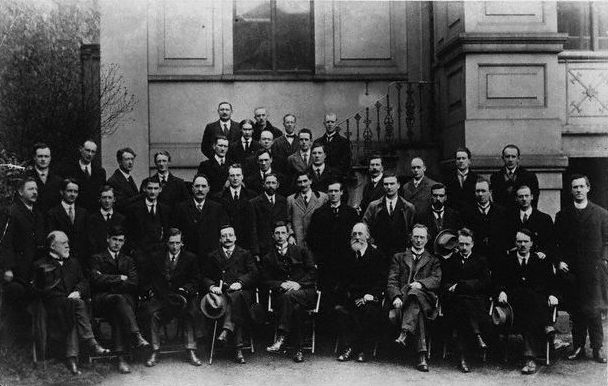
On the same day, two Royal Irish Constabulary officers were killed in the Soloheadbeg ambush by Irish Volunteers, a paramilitary organisation established in 1913 by nationalists and republicans, acting on their own initiative. The Irish War of Independence soon followed and in September 1919 the British government outlawed Dáil Eireann and Sinn Féin. In August 1920 Dáil Eireann adopted a motion that the Irish Volunteers would swear allegiance to the Dáil and the Republic as a state army, becoming the Irish Republican Army (IRA). The 1920s marked the start of divisions and factions in Sinn Féin, as will be addressed in the second blog of this series.
KOR
Further Reading:
Ireland in Transition, 1867-1921, ed. by D. George Boyce and Alan O’Day (2004)
Eoin Ó Broin, Sinn Féin and the Politics of Left Republicanism (2009)
R. F. Foster, Modern Ireland, 1600-1972 (1988)
