

In our latest blog we’re returning to the ‘Recovering Europe’s Parliamentary Culture, 1500-1700’ project. Since late September, we’ve been working with the University of Oxford and the Centre for Intellectual History at the University of Oxford to put together series of blogs that explore European Parliamentary Culture. The series is focused on the Early Modern period – roughly 1500-1700 – but they have ranged more widely, seeking to bring in some scholars of the more recent past to provide different perspectives and insights that might stimulate new thinking. We’re reposting some of the blogs here, with thanks to the CIH and to our colleagues who have commissioned, edited and authored the blogs. To find out more about the exciting programme of work and conferences over the coming year, head to the CIH website.
This blog was initially posted on 18 November 2021, written by Michel Hébert, Emeritus Professor, Université du Québec à Montréal.
Is there any such thing as a parliamentary culture in pre-modern Europe, before Thomas More’s England, before the great Polish Sejm held at Radom in 1505 or before the revolutionary States General in the sixteenth-century Low Countries? Admittedly, the first laid claim to free speech in the House of Commons, the second was granted the privilege of common consent and the third ousted a king and founded a republic. Such significant advances, however, were not and, indeed could not, be born from scratch. They belonged to a recognizable form of parliamentary culture, a transnational inheritance of ideas melting into a common European tradition. As such, they rested upon an age-old culture, or rather a mix of common practices, pertaining to such multifarious spheres as voting patterns, petitioning cultures, assembly practices, altogether embedded in nascent legal frameworks, ideological representations of society and the rise of the Modern State, from the thirteenth century onward, if not even earlier.
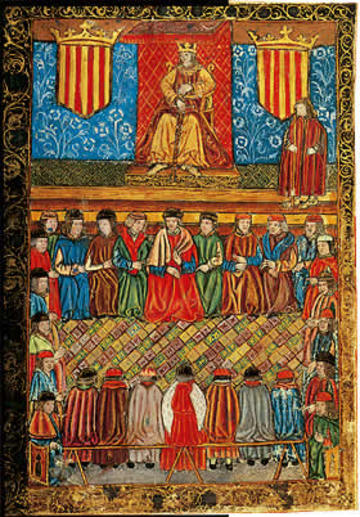
The history of medieval representative assemblies is largely dominated by a functional paradigm that tends to emphasize the study of their role in the institutional development of the states and principalities that were being formed during the closing centuries of the Middle Ages. This role was twofold: first, submission by the people of a number of grievances in the form of petitions or supplications, to which princes were requested graciously to respond; and second, the granting of extraordinary fiscal resources that princes could not reasonably obtain without the consent of their subjects so assembled. Medieval assemblies have been thriving, under different names (parliaments, states general, cortes), throughout the Latin Christian world, from Poland to Portugal and from Scotland to Sicily. They originated from ancient feudal, and highly ceremonial, gatherings such as public crownings or solemn judicial sentencings, often staged in ecclesiastical settings such as general councils, from where they migrated to secular polities from the thirteenth century onward. It has been stressed that such assemblies could not by any means be deemed constitutional, nor could they be considered representative in a modern sense.
Nevertheless, and this is a key figure of early medieval political assemblies, they foreshadowed future developments of representation, inasmuch as they acted as impersonations of political communities, equating ritually formalized bodies to the featuring of the entire community of given regnal or seigneurial entities. One landmark of this evolution was the admittance in such bodies, at a fairly early stage, of subjects beyond the traditional elites of lay and clerical aristocracies: knights of the shire in England, and local magistrates of cities, towns and boroughs in continental Europe, which, in some places, included guild craftsmen. Initial steps toward institutionalization followed, through the election of members, through the crafting of cautiously worded proxies, through the allocation of rights to seat, through the granting of special safeguards to such participants. All in all, though immensely variable in such a vast array of polities, these steps led to what might be the most significant contribution of medieval assembly practices to the modern parliamentarian culture, that of the symbolization of a community through a body empowered to effectively and legally bind each and every member of these communities to the decisions enacted in their name.
Such wordings as « the community of the realm » in England, assemblies « constituting and representing the three estates » in France or the « general of the land » in Catalonia, all in their own way, tend toward a more accurate expression of this new political abstraction, that of a people simultaneously created by and empowered through its’ own representation. This cultural accomplishment clearly epitomizes what John Austin defined as performativity, as the art of doing things with words by following general principles of time, place, authority and so on. More generally, it rests on a number of legal fictions typical of a widely, albeit at times diffuse and ecclesiastically mediated, tradition of Roman legal culture: the general principle according to which what concerns everybody must be approved by everybody, the general standards of elections and voting through the rising practice of strict majority rules, forcing, in turn, the recognition of the fundamental equation of the democratic mind: that the majority’s will perfectly enacts the general will.

A central feature of medieval parliaments – or pre-parliaments, as they should rather be called – is their dependence on regal or princely authority. As G.O. Sayles bluntly put it many years ago, the medieval English parliament is clearly the “king’s parliament” and, across continental Europe, assemblies hinge upon princely authorizations to be convened. Numerous attempts to gain rights of self-summoning, for instance, were met with unwavering opposition; and princely presence, in formal wear and dominant seating positions, was required in order to legitimate words pronounced and deeds enacted in such solemn venues. Unsurprisingly, the symbolic features of such gatherings prevailed in every aspect of their celebration…
To continue reading this blog on the University of Oxford Centre for Intellectual History’s website, click here.
Michel Hébert
